

Being forged, not fixed, is the biblical alternative to self-optimization. Forging is the process by which God uses suffering, resistance, and time to remake a leader into someone who could not have existed without the fire. Unlike fixing, which assumes a broken part to replace, forging assumes a whole person who must be transformed. It is slower, costlier, and the only process Scripture actually testifies to.
What Is Wrong With the Self-Help Model of Fixing?
The self-help industry sells fixing.
Five steps to fix your morning. Seven habits to fix your career. Twelve principles to fix your marriage. Twenty-one days to fix your mindset.
The U.S. self-improvement market was valued at $16.5 billion in 2024 and is projected to reach $28.3 billion by 2033, according to Custom Market Insights. That entire market is built on one assumption: that you are a broken machine, that the right diagnostic will identify the failed components, and that the right system will put you back in working order.
Then you will run smoothly.
Christian leaders absorb this language without noticing it. They attend church on Sunday and learn that God loves them. They attend a leadership conference on Monday and learn that their morning routine is the problem. They read their Bible at 5 a.m. and their productivity book at 6 a.m., treating both as part of the same self-improvement project.
They are not the same project. They are not even in the same category.
C.S. Lewis wrote in The Problem of Pain that "God whispers to us in our pleasures, speaks in our conscience, but shouts in our pains." The self-help industry has no framework for the shout. It only knows how to sell you a better morning routine.
Scripture has a different word for what God does to a man.
Forging.
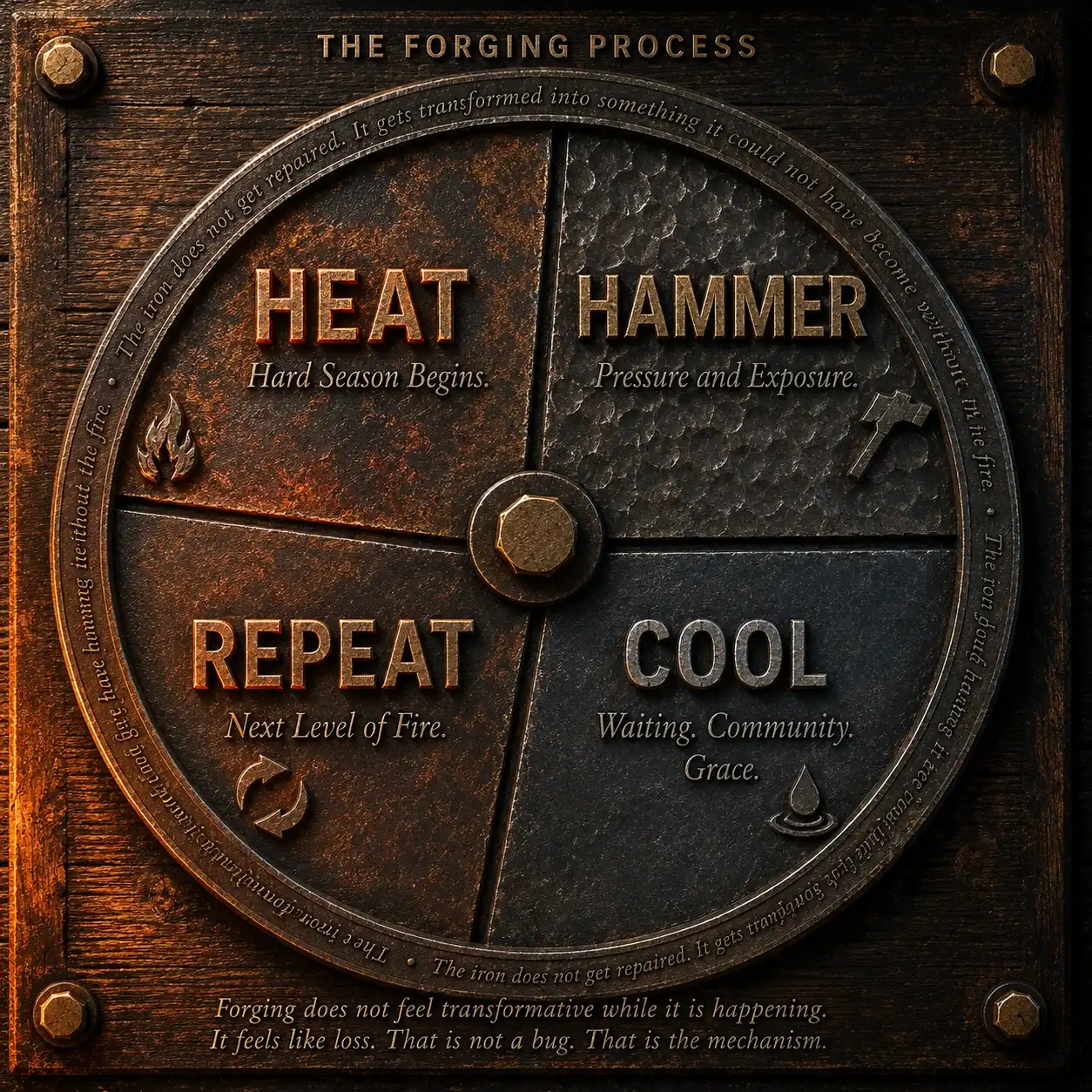
Forging is what happens to iron when it is heated, hammered, cooled, and hammered again. The iron does not get repaired. It gets transformed into something it could not have become without the fire.
You will not be fixed. You can be forged.
This article is about the difference and why understanding it could save you a decade of trying to optimize your way out of a season that was assigned to you.
What Does Scripture Say About Human Nature That Self-Help Gets Wrong?
The self-help vision of the human being rests on one of two assumptions. Either you are fundamentally good and need better tools to release your potential. Or you are fundamentally neutral, a blank system that needs the right inputs.
Both assumptions are wrong. Scripture is not subtle about it.
The Bible's anthropology is more complicated and, ultimately, more honest. You are made in the image of God, which means you have genuine dignity and capacity. You have also fallen, which means that capacity is bent and self-serving in ways you cannot fully see. You are redeemable, which means transformation is possible, but not through self-effort. And you are being sanctified, which means the transformation is real, slow, and painful, and it never reaches completion in this life.
That fourfold picture, made in the image, fallen, redeemable, and being sanctified, makes fixing the wrong frame entirely.
There is no broken part to identify and replace. There is a whole person who must be remade.
The leader who keeps using self-help techniques on Monday to fix what Sunday revealed is caught in what RNH Media calls the Sunday-Monday Gap: the operational distance between a leader's stated theological convictions and the decisions that leader actually makes under pressure. The Sunday-Monday Gap is not a knowledge problem. It is a formation problem. And formation requires forging, not fixing.
The leader who tries to fix himself with techniques will eventually collapse because the parts the techniques cannot reach are precisely the ones that will break him.
What Is the Biblical Pattern for How God Transforms a Leader?
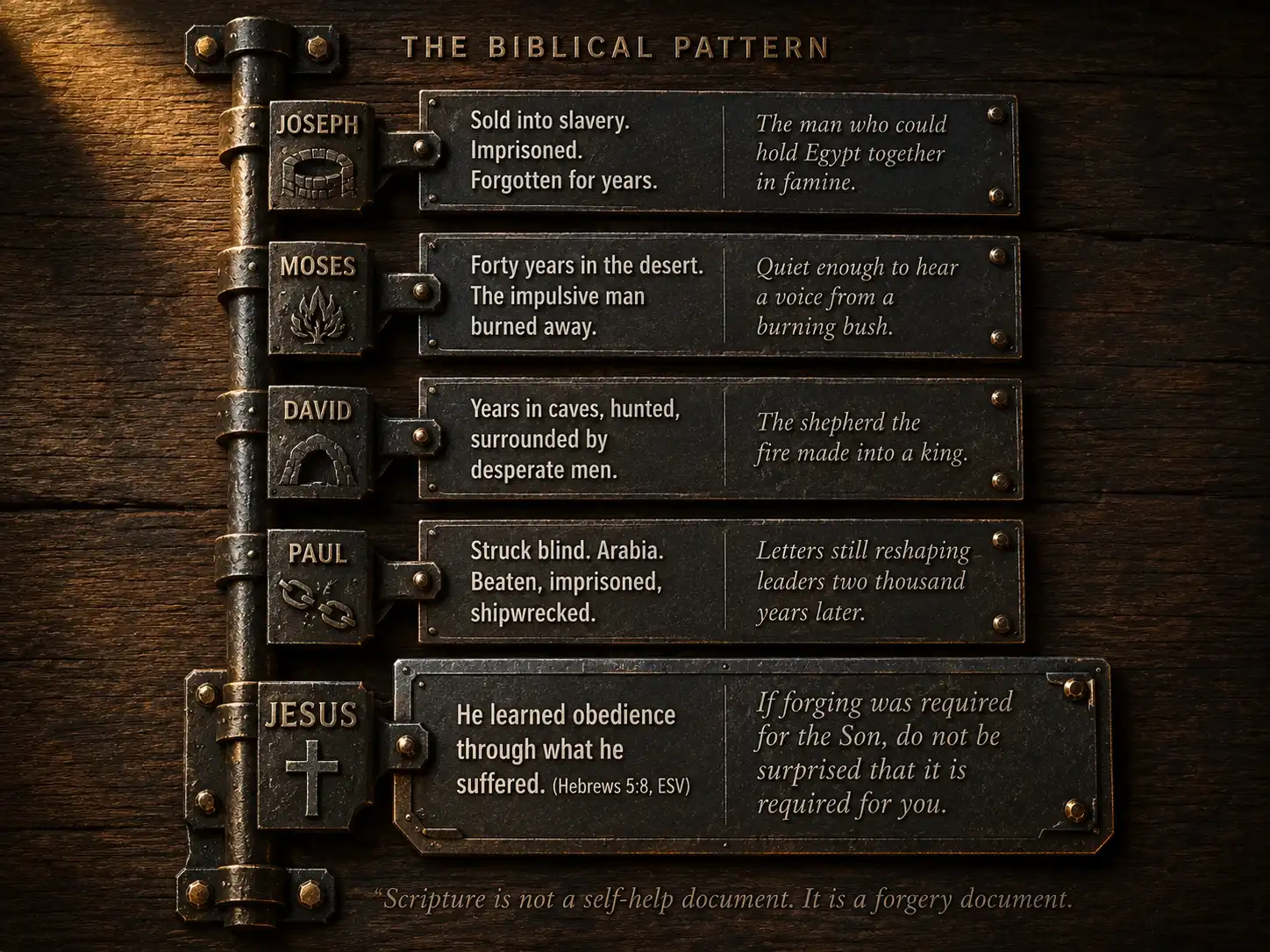
Scripture is not a self-help document. It is a forgery document.
Joseph is not fixed. He is sold into slavery, thrown into prison, and forgotten for years. Only after all of that does the man emerge who can hold Egypt together during a famine and reconcile with brothers who betrayed him. No technique produces that man. The fire does.
Moses is not fixed. He spends forty years in a desert until the impulsive young man who killed an Egyptian in anger has been burned away. What remains is a man quiet enough to hear a voice from a burning bush. That man leads a nation through the wilderness. The desert makes him. No workshop does.
David is not fixed. He spends years in caves, hunted by a king he could have killed, surrounded by men in desperate circumstances, before the shepherd becomes the king God intended. The caves make him. No leadership curriculum does.
Paul is not fixed. He is struck blind, taught in Arabia for years, beaten, imprisoned, shipwrecked, and repeatedly brought to the edge of death. The letters he writes from those edges are the ones still reshaping leaders two thousand years later. No conference does that.
Jesus is not fixed. He is the only sinless person in the whole story. And even he, the writer of Hebrews, tells us, "learned obedience through what he suffered" (Hebrews 5:8, ESV). The eternal Son was forged through a real human life because the kind of obedience God required could only be produced that way.
If forging was required for the Son, do not be surprised that it is required for you.
What Does Forging Actually Look Like in the Life of a Modern Leader?
Forging in your life looks like seasons you would not have chosen.
The business that fails after seven years of real effort. The marriage that passes through years of genuine difficulty. The church plant that does not grow the way the books said it would. The relationship that breaks and does not get repaired on your timeline. The health crisis arrived when the momentum was finally building.
Forging does not feel transformative while it is happening. It feels like loss. It feels like fatigue. It feels like quiet erosion.
That is not a bug in the process. That is the mechanism.
There are versions of you that can only exist on the other side of the fire. The fire is not interrupting your development. It is your development.
Most leaders try to escape the fire. Some succeed for a season. They produce the fixed version of themselves, competent, polished, and functional, and they spend the rest of their lives trying to maintain it with diminishing effort and growing fragility.
What Is the Difference Between Suffering and Forging?
Suffering is not automatically forging. This is where most people misread the process.
Suffering can produce bitterness. It can produce cynicism, hardness, addiction, withdrawal, and a long list of other deformations. Most people who go through hard seasons do not emerge refined. They emerge damaged and spend their remaining energy avoiding anything that resembles the fire that hurt them.
What turns suffering into forging is the sufferer's orientation
A man in suffering who turns toward God gets forged. A man in suffering who turns away from God gets something else. Same fire. Entirely different outcome.
This is what Romans 8:28 actually says, when read carefully and completely:
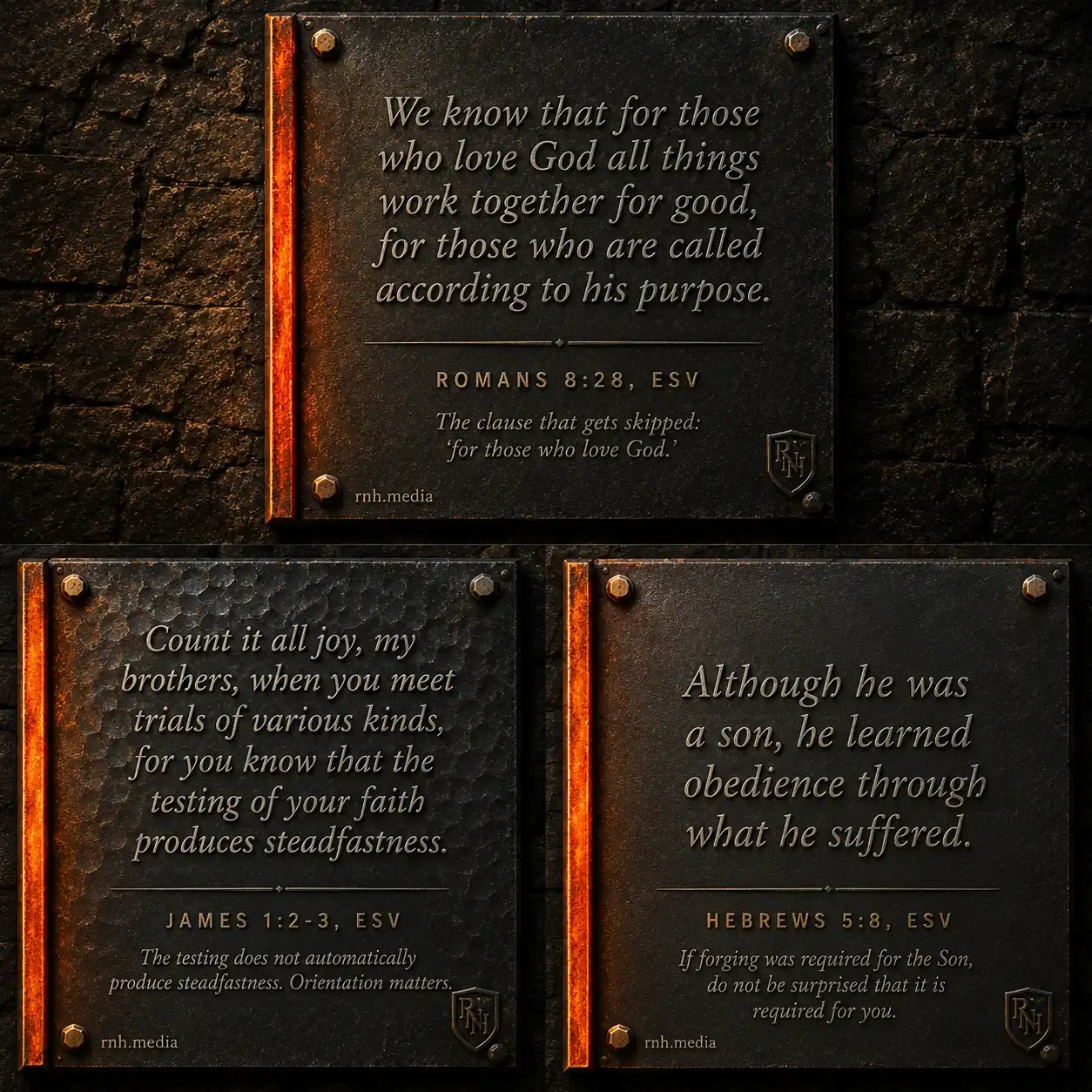
"We know that for those who love God all things work together for good, for those who are called according to his purpose." (Romans 8:28, ESV)
The clause that almost always gets skipped is for those who love God. The promise is not that all things produce good for everyone. The promise is that all things, including the hardest things, work together for good for those whose orientation is toward God.
James says it this way: "Count it all joy, my brothers, when you meet trials of various kinds, for you know that the testing of your faith produces steadfastness." (James 1:2-3, ESV) The testing does not automatically produce steadfastness. It produces steadfastness in those who receive it as a test and remain oriented toward what they know.
Turning toward God in the fire is not a one-time decision. It is a thousand small choices made over months and years, many of them made when you do not feel like making them.
That orientation, repeated under pressure, is what turns iron into a sword.
What Does a Forged Leader Look Like Compared to a Fixed Leader?
"The fixed man is more impressive in the conference room. The forged man is the one you call at 11 p.m. when the thing that cannot fall apart is falling apart."
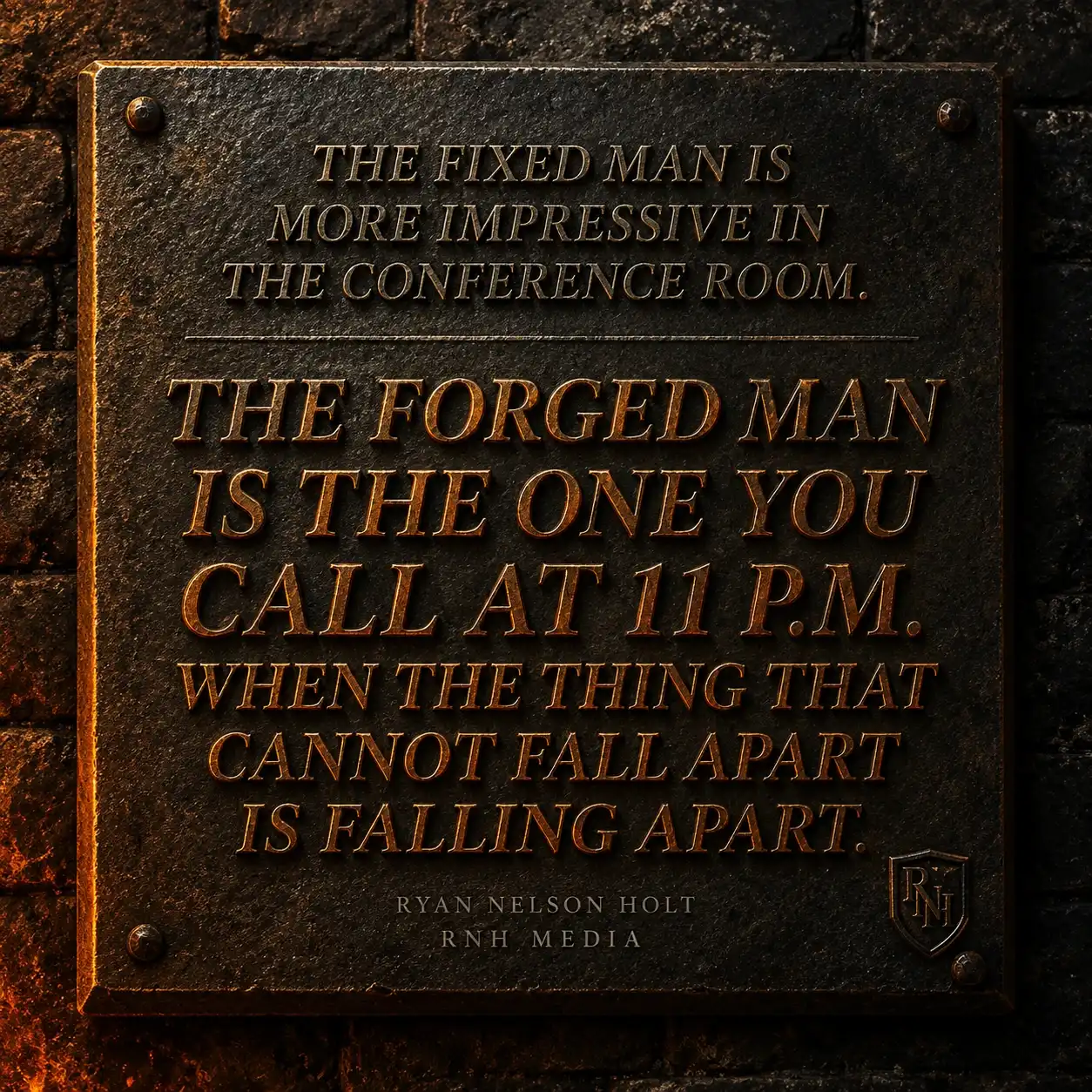
The difference between a fixed man and a forged man is not visible on a resume. It shows up under pressure.
| The Fixed Man | The Forged Man | |
|---|---|---|
| How he was made | Optimized through technique | Transformed through suffering |
| Appearance | Polished, impressive, confident | Quiet, present, settled |
| Under pressure | Performs well in controlled settings | Functions when things fall apart |
| Response to crisis | Seeks the right framework | Has been through fire before |
| Relationship to God | Uses grace as a productivity tool | Has been broken and rebuilt by grace |
| Long-term reliability | Requires maintenance and re-optimization | Carries weight others cannot |
| Who calls him | Conference organizers | Friends at 11 p.m. |
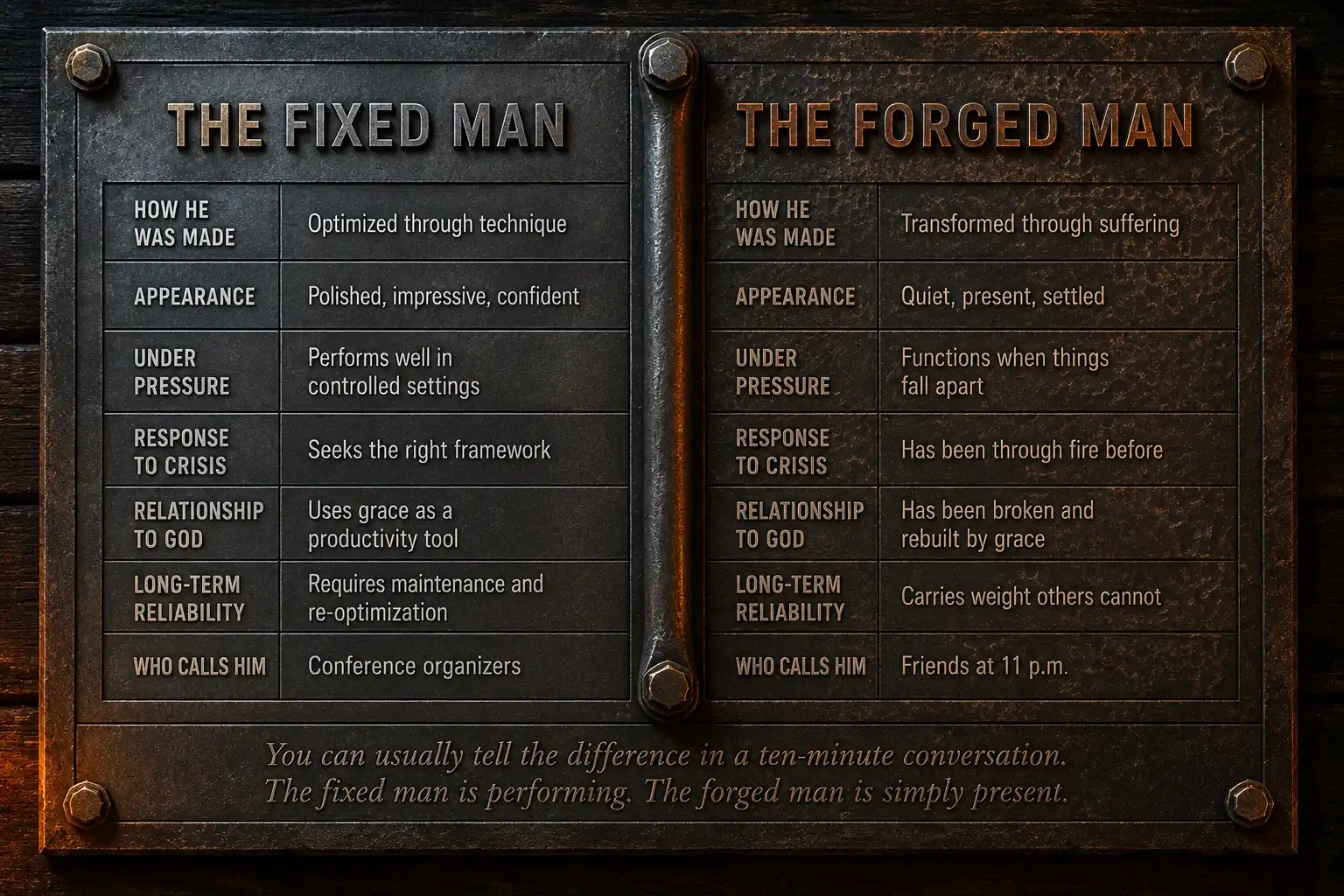
The fixed man is shinier. He has the right vocabulary, the right systems, the right relationships, the right morning routine. He performs well in most situations. He is optimized.
The forged man is quieter. He has been through fires that taught him things the fixed man does not know and cannot imitate. He is not easily impressed. He does not panic. He can carry weight that would break the average man.
You can usually tell the difference in a ten-minute conversation. The fixed man is performing. The forged man is simply present.
The world wants more fixed men. They are easier to manage, easier to impress, easier to market to. The Kingdom needs more forged men because the work that truly matters requires someone who has already been through the fire and is unafraid of it.
How Do You Let Yourself Be Forged Instead of Trying to Escape?
You cannot manufacture forging. You can refuse it, and most people do. You can also let it happen. Here is what that looks like in practice.
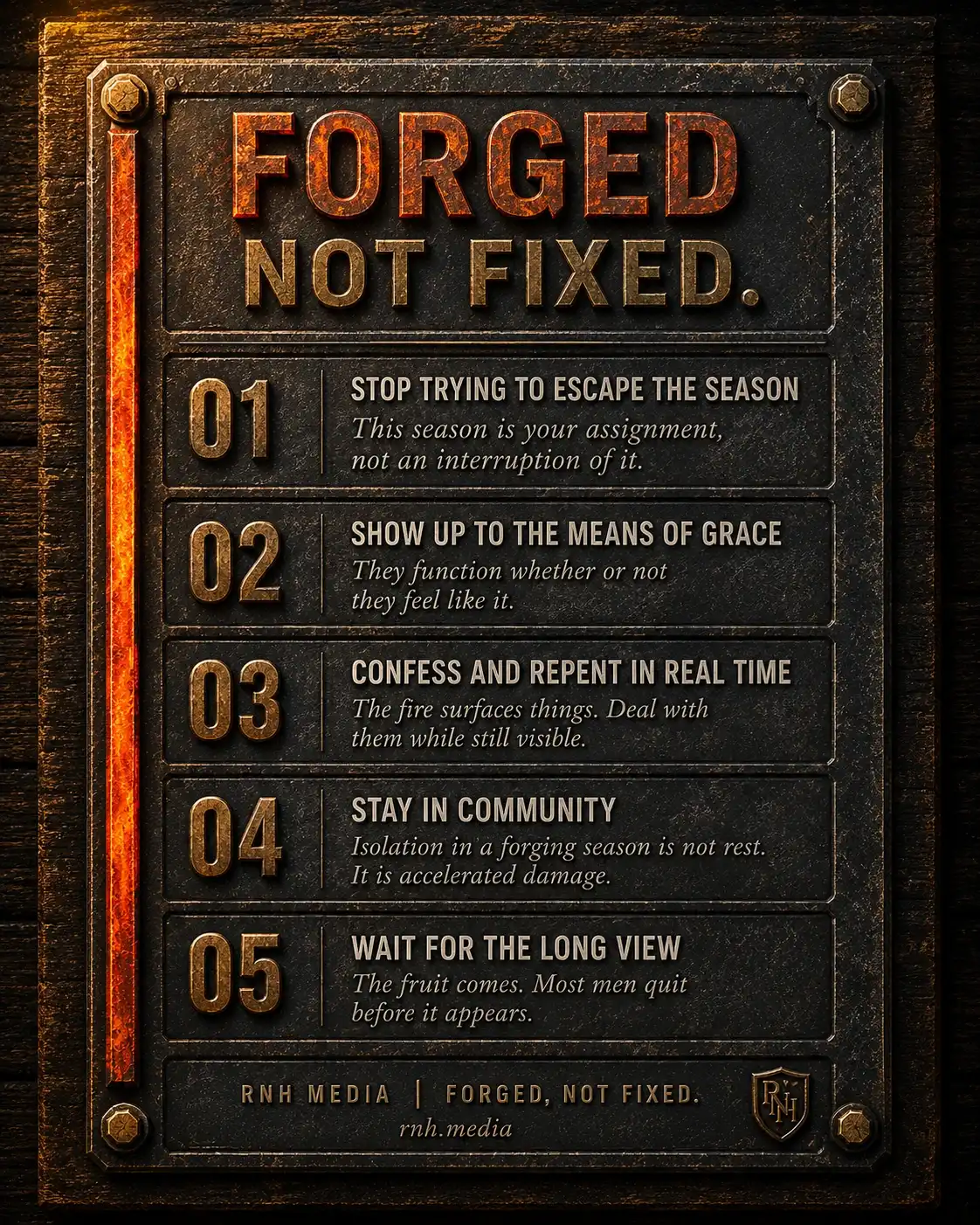
Practice 1: Stop Trying to Escape the Season
Most leaders in a hard season spend most of their energy trying to end it. The marketing pivot. The new strategy. The different city. The fresh start.
Some of those efforts are appropriate. Most are dressed up as escapees
Letting yourself be forged means accepting that this season is your assignment, not an interruption of it. Ask what this season is producing in you, not just what it is costing you. The fire does not ask your permission. The only question is what you do while you are in it.
Practice 2: Show Up to the Means of Grace
In a forging season, the means of grace feel less effective, not more. Scripture feels dry. Prayer feels hollow. Worship feels like going through the motions.
Show up anyway.
The means of grace are not for easy seasons. They are the channels God uses to do his formative work, and they function whether or not they feel like it. Read your Bible. Pray. Worship. Take the sacraments. Stay in fellowship, especially when none of it feels like it is working.
Hebrews 12:11 is worth keeping close: "No discipline seems pleasant at the time, but painful. Later on, however, it produces a harvest of righteousness and peace for those who have been trained by it." (ESV) The key phrase is for those Scriptures that are Scriptures it. The training requires showing up.
Practice 3: Confess and Repent in Real Time
Forging exposes things. Sin patterns you thought you had under control. Idolatries you did not know were operating. Character deficiencies you had papered over with competence.
The fire surfaces these. The work is to confess and repent as they surface, not to manage them or bury them and wait for the season to end.
Most leaders in a forging season add a decade to their formation by burying what the fire reveals rather than dealing with it while it is visible.
Practice 4: Stay in Community
The forging season is the season most likely to push you into isolation, because community feels costly when you are already depleted.
Stay in your close friendships. Stay in your church. Stay accountable to your wife. Stay connected to a mentor or a brotherhood. The fire does not do its best work in isolation. It does its worst work there.
Isolation in a forging season is not rest. It is accelerated damage. The men who come out of the fire whole almost always had at least one other person who stayed with them through it.
Practice 5: Wait for the Long View
The fruit of forging is not visible in real time. It is visible at a decade scale, sometimes longer.
Most men quit before the fruit appears. They walk away from a marriage that would have become beautiful. They leave a church that was about to produce something real. They abandon a calling three years before the breakthrough.
Stay. The fruit comes. The men you most respect stayed when staying made no obvious sense. That is the only reason you respect them.
Why the Forged Path Is the Only Path Worth Taking
You cannot be fixed. The fixing language is a category error applied to a human soul.
You can be forged. The forging is real, costly, and slow. And it produces something the fixing process cannot touch.
The fire is already in your life in some form. You are not getting out of it.
You can refuse it and become a damaged version of yourself.
You can endure it without orientation and become a brittle version of yourself.
Or you can turn toward God in it, repeatedly, over years, and become the forged version of yourself.
The third path is the only one worth taking. It is also the only Scripture that testifies to the path of a leader who lasts.
Frequently Asked Questions
What does it mean to be forged, not fixed, as a leader?
Being forged means submitting to a God-directed process of transformation through suffering, resistance, and time, and being fixed means trying to optimize or repair yourself through techniques and systems. Scripture presents forging as God's actual method for leader formation. Fixing is the self-help industry's substitute.
What is the difference between suffering and forging?
Suffering is not automatically forging. What converts suffering into forging is the person's orientation in the fire. A leader who turns toward God under pressure gets forged. A leader who turns away gets damaged. Same fire, different outcome.
What biblical figures went through a forging process?
Joseph, Moses, David, Paul, and Jesus each went through extended seasons of suffering that Scripture presents not as interruptions to their calling but as the mechanism of their formation. Even Jesus, sinless, "learned obedience through what he suffered" (Hebrews 5:8, ESV).
How do I know if I am in a forging season?
A forging season involves prolonged difficulty you did notchoosee and that cannot be ended through effort alone. It exposes sin patterns, tests relationships, and resists resolution. Take the Drift Diagnostic for an honest read on where your orientation is right now.
What is The Foundry at RNH Media?
The Foundry is the RNH Media membership community for faith-driven leaders in a season of forging. It is built on the conviction that leaders are forged, not fixed, and that the fire does its best work in community, not isolation.
Next Steps
If you suspect you are in a forging season and have been treating it as an interruption, take the Drift Diagnostic for an honest read on where your orientation is.
The Foundry exists to put leaders in community while they are being forged, so they do not go through the fire alone. It is built on the conviction that forging does its best work in brotherhood, not isolation.
Subscribe to The Arena Letter for weekly notes from the field on faith-driven leadership, the Sunday-Monday Gap, and what it looks like to lead well when the fire is on.
In The Arena.
Ryan Nelson Holt is the founder of RNH Media and the author of In The Arena, writing on faith-driven leadership for Christian operators.
Last reviewed: June 2026escapees