

Prefer to listen?
Hear a full discussion of this week's theme below.
Twenty minutes. One idea. Take it with you.

I write this from a dialysis chair: spans a week, four hours per session. I am also legally blind. I tell you this not for sympathy. I tell you this because the leadership content industry has a massive blind spot: it assumes ideal conditions.
This guide is for the leader who is building something that matters while navigating constraints that most leadership books pretend do not exist.
The Myth of Ideal Conditions
Every leadership framework you have consumed carries an implicit assumption: you have the time, energy, health, and resources to implement it. The 4:00 AM routine. The 60-hour week. The travel schedule covers three continents.
These frameworks are not wrong. They are incomplete. They serve a specific leader in specific conditions. If that is not you, they create guilt. And guilt is the enemy of effective leadership.
Constraints are the norm. Financial. Health. Family obligations. Energy limitations. Every leader operates under constraints. The question is whether you lead through them or hide behind them.
Reframing Constraints
"My grace is sufficient for you, for my power is made perfect in weakness." (2 Corinthians 12:9, ESV)
Paul understood what modern leaders refuse to accept: limitation is not the opposite of effectiveness. It is often the catalyst. When you cannot outwork everyone, you learn to outthink them. When your energy is limited, you invest it with precision rather than scatter it with volume.
The constraint forces creativity. It eliminates brute force and demands elegance.
Four Types of Constraints
Physical Constraints
Chronic illness. Disability. Recovery. These affect energy, schedule, and capacity. The reframe: physical constraints force energy stewardship rather than reckless spending. I produce content and coach leaders from a dialysis chair, not; despite, it. Through the disciplines it taught me.
Financial Constraints
Bootstrap budgets. No investor backing. Limited runway. The reframe: financial constraints kill waste. Every dollar justifies itself. The lean of stewardship never learns.
Time Constraints
involve stewardship and leadership stewardship-and-leadership.
Situational Constraints
Geographic isolation. Regulatory requirements. Industry barriers. The reframe: situational constraints often become your unique value proposition. My FINRA constraints forced me into the stewardship-and-leadership lane. The constraint became the differentiator.
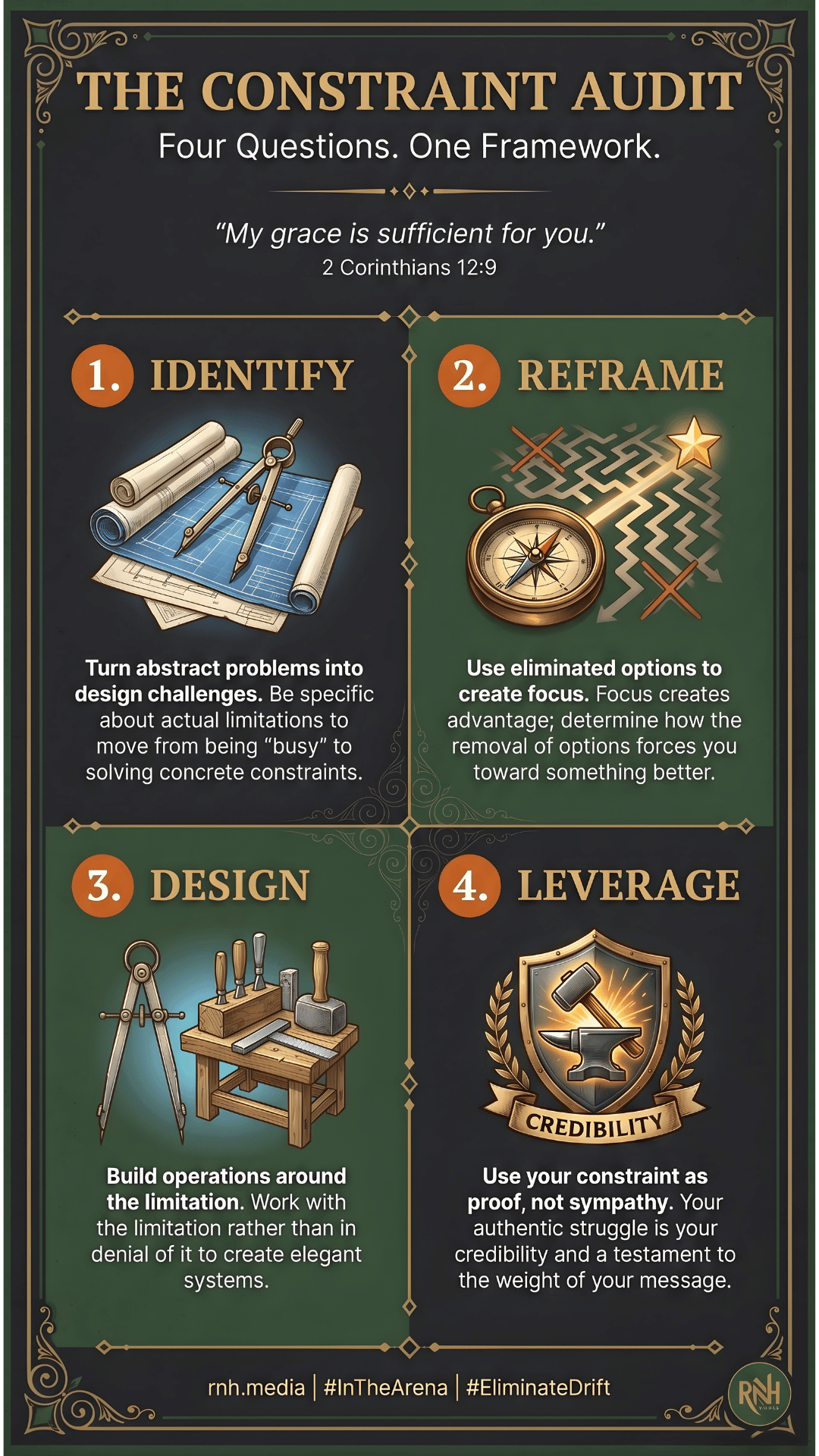
The Constraint Audit
Question 1: What Are My Actual Constraints?
Be specific. Not 'I am busy.' Specific: 'I have 25 available working hours per week due to dialysis on Tuesday, Thursday, and Saturday.' Specificity turns an abstract problem into a concrete design challenge.
Question 2: What Advantage Does This Constraint Create?
Every constraint eliminates options. Eliminated options create focus. Focus creates advantage. What can you not do, and how does that removal force you toward something better?
Question 3: What System Fits This Constraint?
strength daysstrengthdays. Work with the limitation, not in denial of it.
Question 4: How Do I Communicate This Authentically?
Your constraint, communicated honestly, becomes a source of strength. It is not sympathy. It is proof. When a man who leads from a dialysis chair teaches discipline, the message carries weight no motivational speaker can match.
Building Constraint-Adapted Systems
Energy mapping: Track your energy across a typical week. Map demanding tasks to high-energy windows. Maintenance tasks and low-energy periods. This is energy stewardship, not time management.
Batching for capacity: Record content in batches during high-capacity windows. One strong session feeds the waterfall strategy for an entire week.
Buffer building: Maintain pre-produced content, pre-written emails, and ,pre-planned tasks. When a constraint flares unexpectedly, the buffer absorbs the impact.
The Testimony of Constraint
My constraints are my most powerful credential. Twenty-one years of sobriety. Years of dialysis. Legal blindness. These are not obstacles I overcame and left behind. They are the daily conditions under which I lead.
Your constraints are not disqualifying you from leadership. They are qualifying you for the specific leadership only you can provide.
Your constraints are not your excuse. They are your forge.
Your Next Step
Complete the Constraint Audit this week. Write down your actual constraints with specificity. Answer the four questions. Design one system change that works with your constraints instead of against them.
Then start building. Not from ideal conditions. From real ones.
In the arena. Always.
_______________________________________________
Ryan Nelson Holt | Founder, RNH Media
In The Arena: Leading, Building, and Fighting The Good Fight
RNH.MEDIA: three