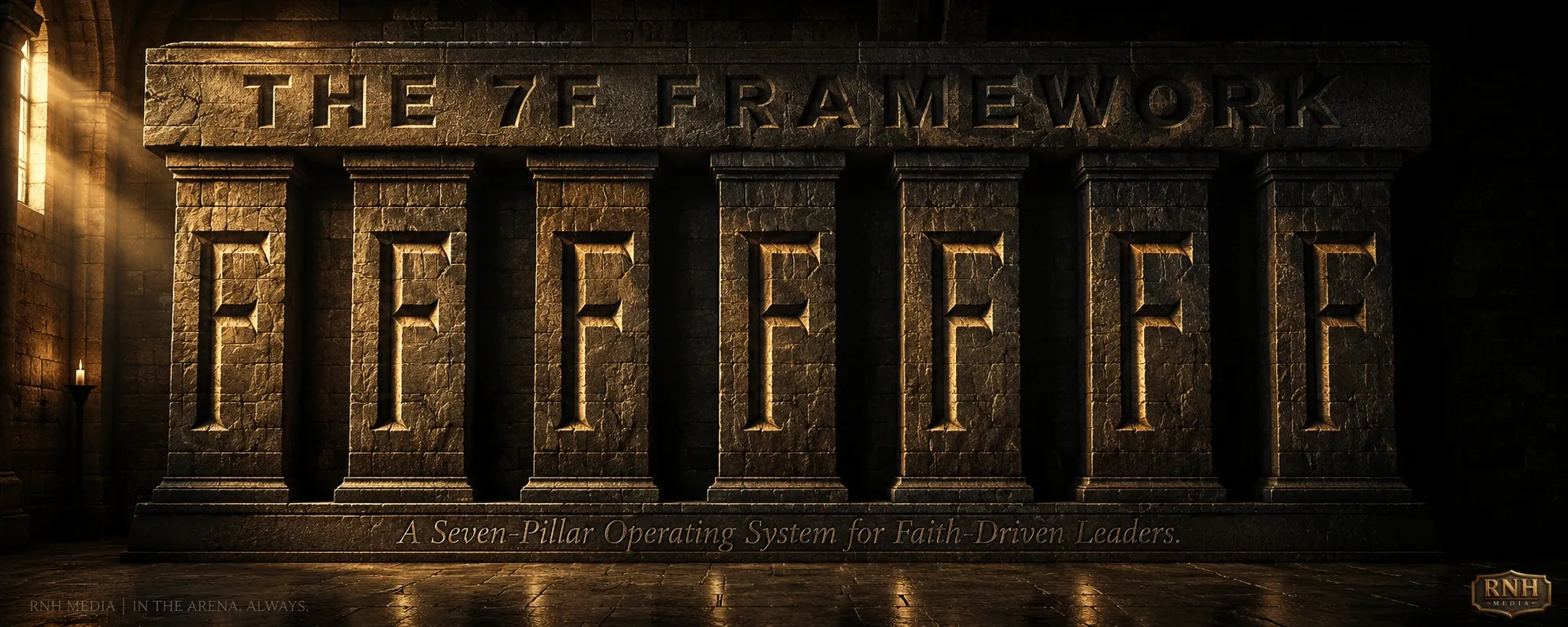
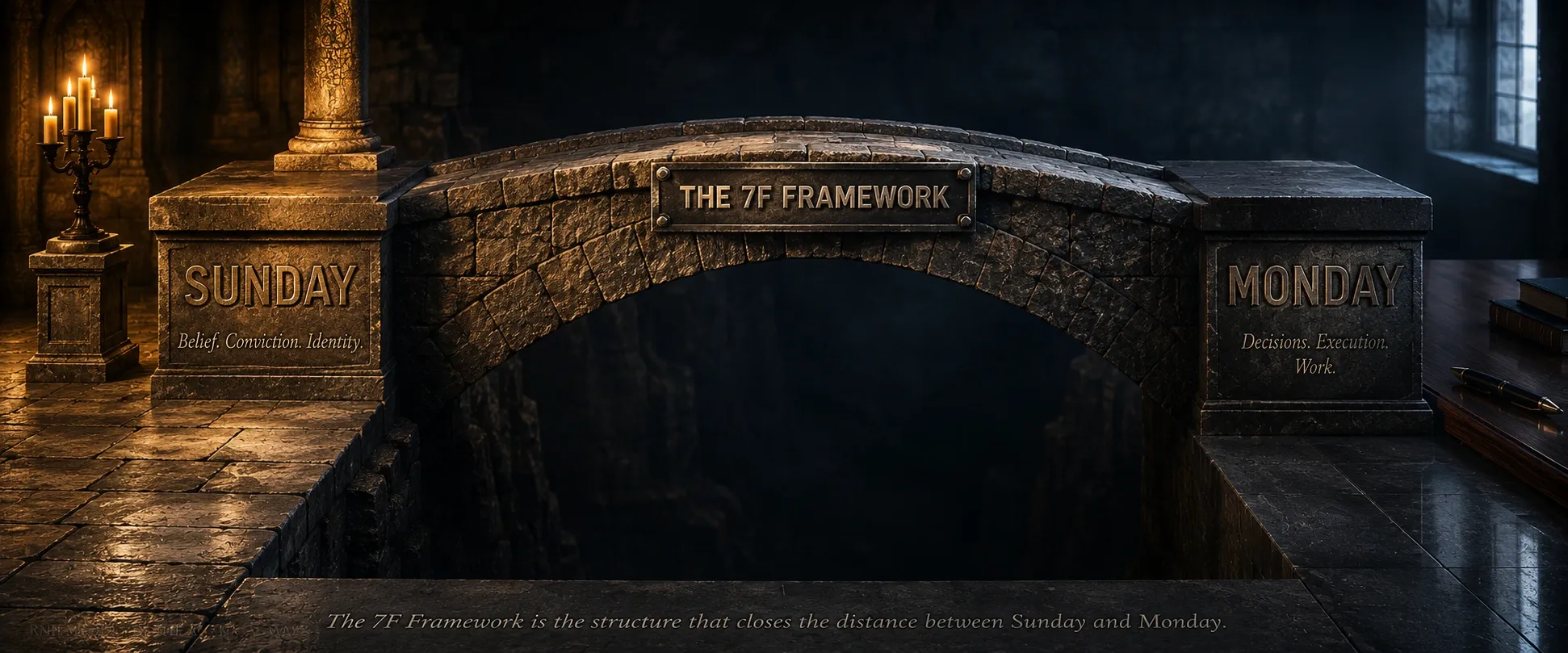
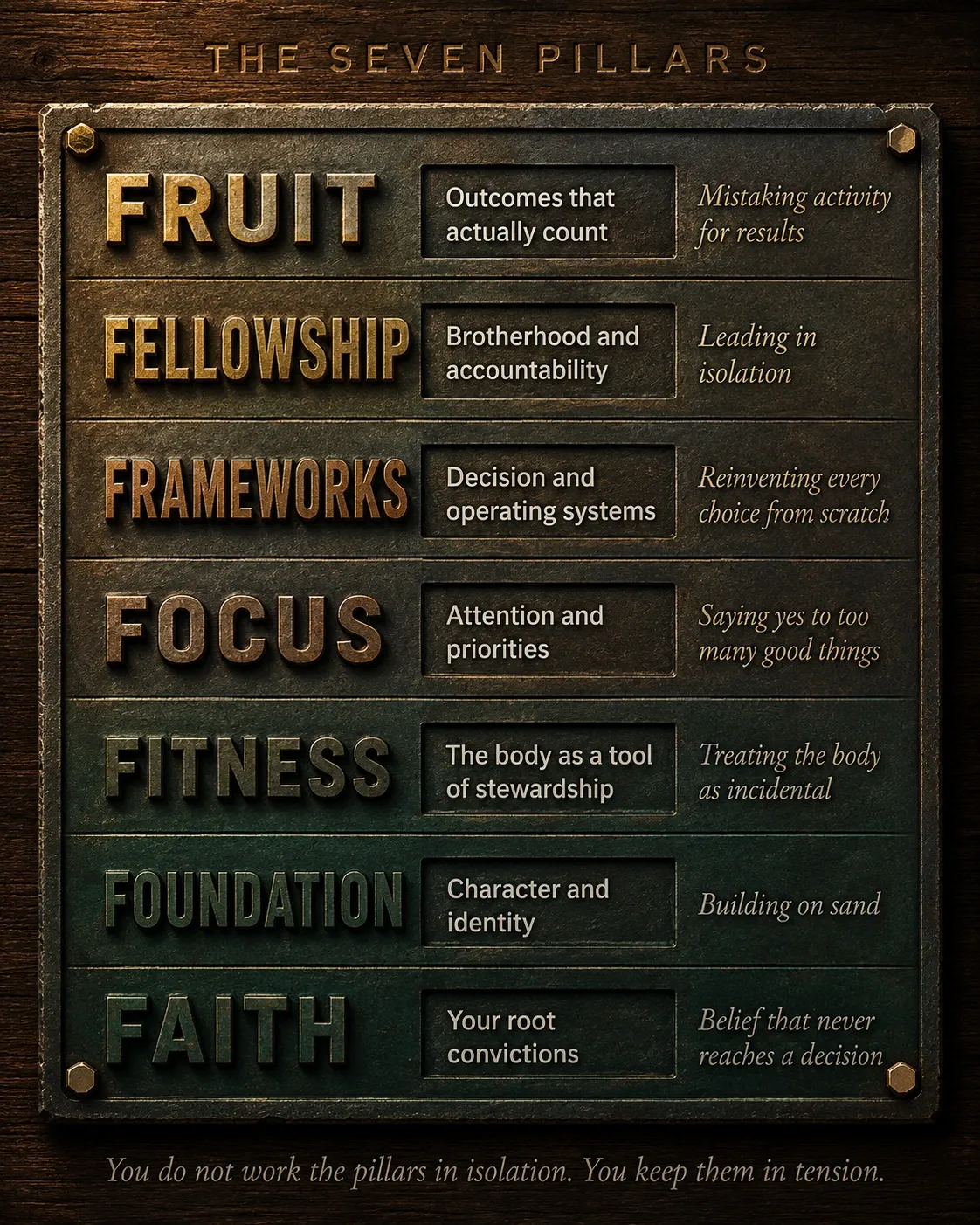
The 7F Framework is a seven-pillar operating system for faith-driven leaders, developed by Ryan Nelson Holt at RNH Media. Its seven pillars are Faith, Foundation, Fitness, Focus, Frameworks, Fellowship, and Fruit. Each names a domain a Christian operator has to govern on purpose, because each is a domain where leaders drift by default. Together, they form a single structure for closing the Sunday-Monday Gap: the distance between conviction and execution.
The framework exists because most leadership advice is either theologically serious and practically useless, or practically sharp and spiritually hollow. The 7F holds both at once.
Here is the short answer:
The 7F Framework is a seven-pillar operating system for faith-driven leaders: Faith, Foundation, Fitness, Focus, Frameworks, Fellowship, and Fruit. Each pillar names a domain a Christian operator must govern deliberately to keep conviction and execution aligned. Used together, the seven pillars form a repeatable structure for diagnosing drift and closing the gap between Sunday belief and Monday behavior.
What are the seven pillars?
Each F is a domain of deliberate governance. Here is the whole structure at a glance.
Why seven, and why these seven?
Because a leader does not fail in one place, he fails across a system. A man with strong faith and a neglected body will eventually be led by exhaustion. A man with sharp frameworks and no fellowship will eventually decide alone and wrongly. The seven pillars are the domains where, in practice, faith-driven leaders consistently drift.
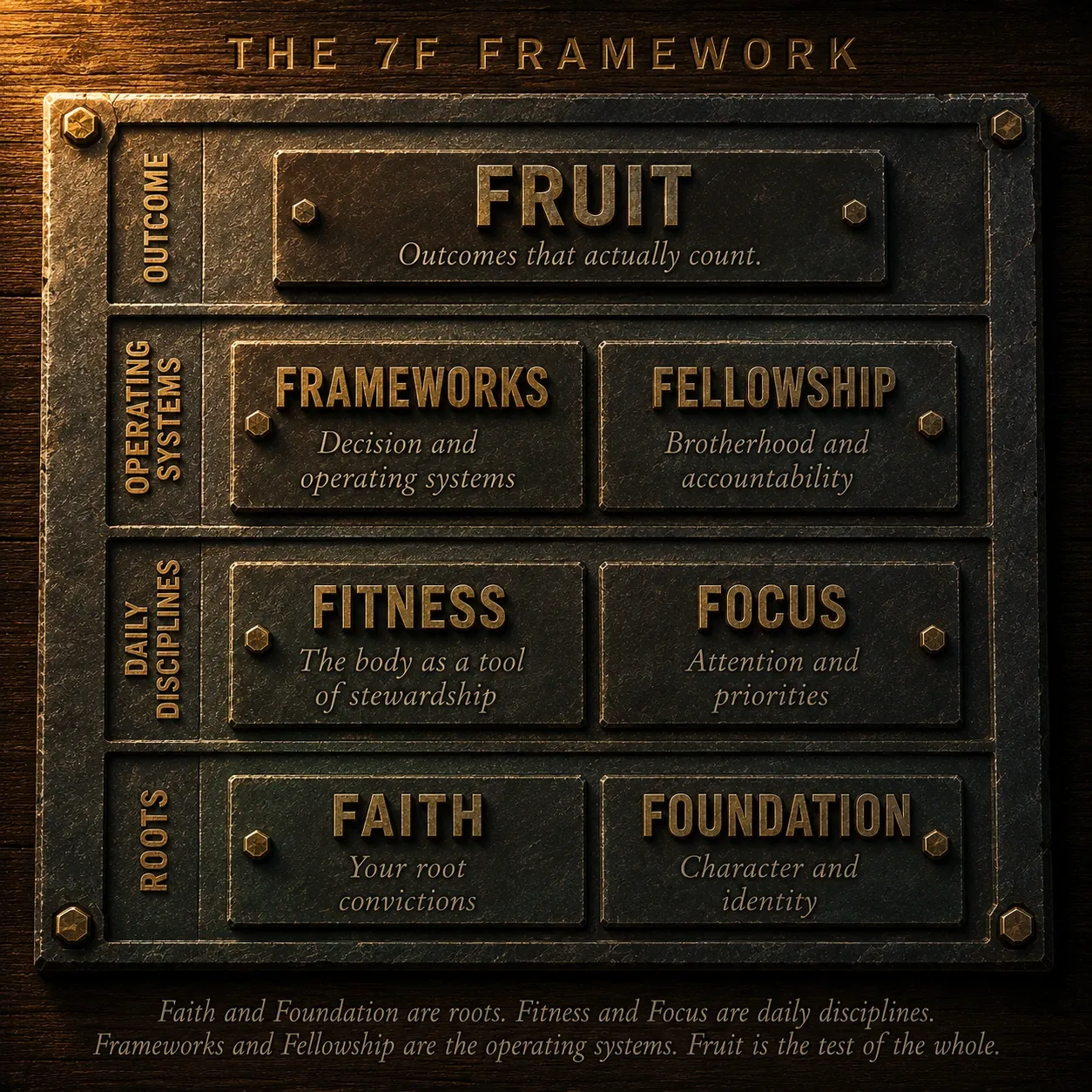
The order is deliberate. Faith and Foundation are roots. Fitness and Focus are daily disciplines. Frameworks and Fellowships are the systems and relationships that carry decisions. Fruit is the test of the whole. You do not work the pillars in isolation. You keep them in tension.
How is the 7F different from other Christian leadership models?
Most faith-and-work models optimize for one thing: calling, virtue, or productivity. The 7F is built for the operator who has to hold it all at once, under real constraints, on a Monday. It is diagnostic before it is aspirational. You start by finding which pillar is drifting, not by admiring the whole.
This is also where the structure earns its keep in AI-era discipleship. Peter Drucker's old line still governs the Fruit pillar: what gets measured gets managed. The 7F refuses to let a leader measure only the comfortable pillars.
How do you actually use it?
Three moves, in order.
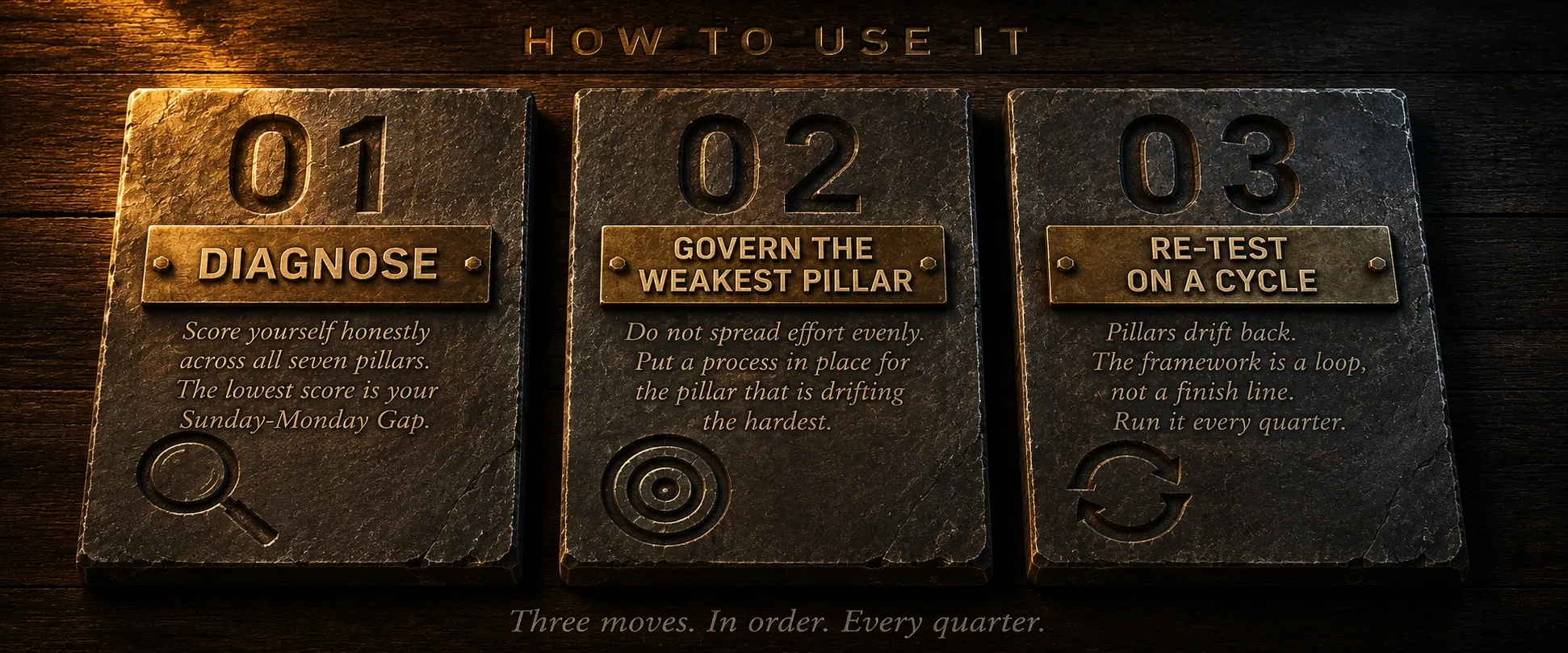
- Diagnose. Score yourself honestly across all seven. The Drift Diagnostic does this in a structured way. The lowest pillar is usually where your Sunday-Monday Gap is widest.
- Govern the weakest pillar first. Do not spread effort evenly. Put a process in place for the one domain that is drifting the hardest.
- Re-test on a cycle. Pillars drift back. The framework is a loop, not a finish line. Run it every quarter.
Frequently Asked Questions
Publish these visibly on the page. They must match the FAQPage schema in the kit below.
What does the 7F Framework stand for?
The seven Fs are Faith, Foundation, Fitness, Focus, Frameworks, Fellowship, and Fruit. Each names a domain a faith-driven leader must govern deliberately to keep conviction and execution aligned.
Who created the 7F Framework?
The 7F Framework was created by Ryan Nelson Holt, founder of RNH Media, as the core operating system for the company's work with Christian operators. It is the structure behind the book In The Arena and the Foundry membership.
Do I have to work all seven pillars at once?
No. The framework is diagnostic first. You score all seven, then govern the weakest pillar first rather than spreading effort evenly. The pillar that is drifting hardest is usually where your gap between belief and behavior is widest.
Is the 7F Framework a religious or a business tool?
Both, by design. It is built for the leader who refuses to separate the two. Faith and Foundation are theological roots; Frameworks and Fruit are operating disciplines. The point is to keep them in the same system.
Internal links to place in this article
- Link each pillar name to its dedicated pillar article (#12 through #18) as those are published.
- Link 'Drift Diagnostic' to the Drift Diagnostic tool page.
- Link 'Sunday-Monday Gap' to article #1.
- Link 'In The Arena' to the book page.
- Link 'Foundry membership' to the Foundry page.
Last reviewed: May 2026.