

The Sunday-Monday Gap is the operational distance between a leader's stated theological convictions and the decisions that the leader actually makes under pressure. It is the space between what a Christian operator affirms in a pew on Sunday and how he negotiates, hires, fires, prices, and competes on Monday. The gap is not hypocrisy in the cartoon sense. It is the slow, unexamined drift that opens when conviction is never translated into a decision-making process.
Most leaders do not choose the gap. They inherit it. They were taught what to believe and never taught how belief governs a Tuesday afternoon when a vendor lies, a number misses, and the room is waiting on a call.
Short answer: The Sunday-Monday Gap is the measurable distance between a Christian leader's stated beliefs and the decisions he actually makes at work under pressure. It widens when conviction is never converted into a repeatable decision process, and it closes through deliberate practices that force belief and behavior into the same room: defined values, accountability, and a method for hard calls.
If you are a Christian CEO, founder, or operator, the question is not whether a gap exists, but how wide it is, where it shows up, and what you are doing about it.
What Is the Sunday-Monday Gap?
Put simply, the Sunday-Monday Gap is the distance between what you confess in worship and what you actually decide when the stakes are high at work. On Sunday, belief can stay abstract; on Monday, every conviction carries a price.
A leader with a narrow gap does not just "believe Christianly"; he has translated belief into operating rules, routines, and constraints that show up in forecasting, hiring, pricing, and performance management. A leader with a wide gap may sincerely affirm orthodox doctrine and yet lead no differently than his secular peers when pressure rises.
Why Does the Gap Open?
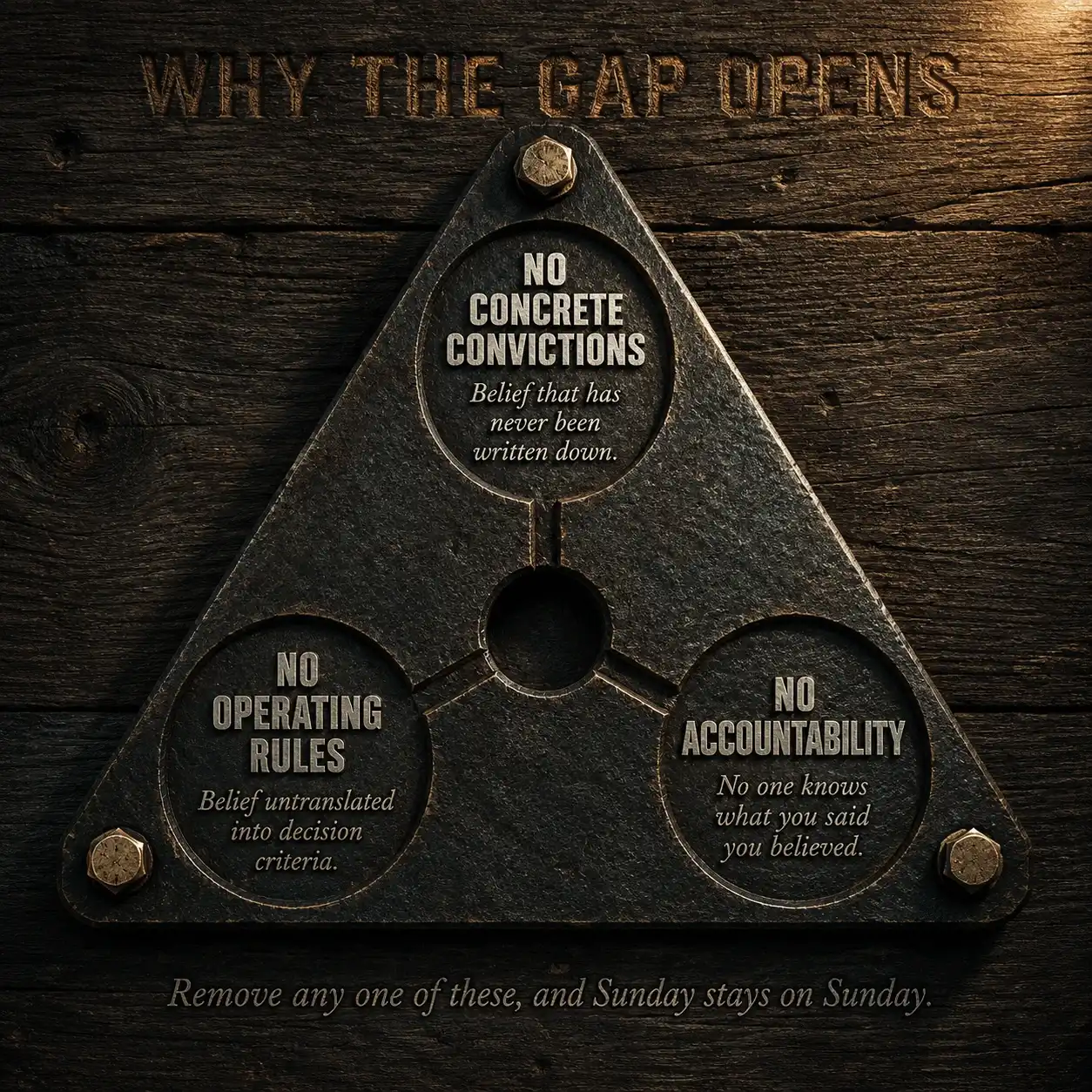
Belief is cheap on Sunday because Sunday asks nothing costly of it. Monday is where conviction meets price. The gap opens because three things rarely happen at once in the life of a leader:
He knows, in concrete terms, what he believes about money, people, truth, and power.
He has translated that belief into specific operating rules that govern real decisions.
He has someone with standing to tell him when he has broken those rules.
The pattern now has data behind it. Barna's 2025 Faith-Forward CEOs study, conducted with C12 Business Forums across 356 U.S. chief executives, found that only about half of self-identified faith-forward CEOs say faith is a highly motivating factor in their leadership, while a quarter say it is not a factor at all. C12's analysis identified the deeper trend: the rise of a leader who is culturally comfortable with Christianity but, in practice, leads no differently from his secular peers.
That is the Sunday-Monday Gap in data.
What Does the Gap Look Like on a Monday?
The gap is rarely dramatic. It looks like small, defensible compromises that compound over time.
Pricing a deal in a way you would not explain from the front of a room.
Keeping a high performer whose conduct you would discipline in anyone else.
Calling something a "stewardship decision" when it was a fear decision.
Praying about a choice you have already made to avoid making it.
Treat Sunday as the audit and Monday as the exception.
In isolation, each decision can be rationalized. Over months and years, they define the organization's real theology: what you truly believe about God, people, and outcomes when it costs you something.
How Is This Different from Ordinary Hypocrisy?
Hypocrisy is knowing and pretending. The gap is usually due to a lack of understanding of the mechanism. A leader can be sincere on Sunday and adrift on Monday because no one ever showed him that conviction without a process is just sentiment.
As Dallas Willard put it, the issue is not the absence of belief but the absence of a deliberate plan to become the kind of person whose actions follow from it. That reframe matters. If the gap were only hypocrisy, the fix would be shame. Because the gap is mostly mechanical, the fix is formation.
Formation is slow, deliberate work: adjusting who you are becoming, how you make decisions, and who is allowed to speak into them.
How Do You Diagnose Your Own Gap?
You do not diagnose the Sunday-Monday Gap in general. You diagnose it in one specific decision at a time. Pick a real decision from the last week, a hire, a firing, a pricing decision, a partnership, a budget cut, and run it through three questions:
What did I say I believe about this kind of situation?
What did I actually do, in concrete terms?
If those two diverged, what did the divergence cost, and who would have told me?
When you compare belief and behavior at this level, the gap becomes visible. You begin to see patterns: where you consistently trade truth for speed, people for profit, or obedience for optics.
Closed vs. Open Gap in Practice
Here is one way to picture the difference between a closed gap and an open one:
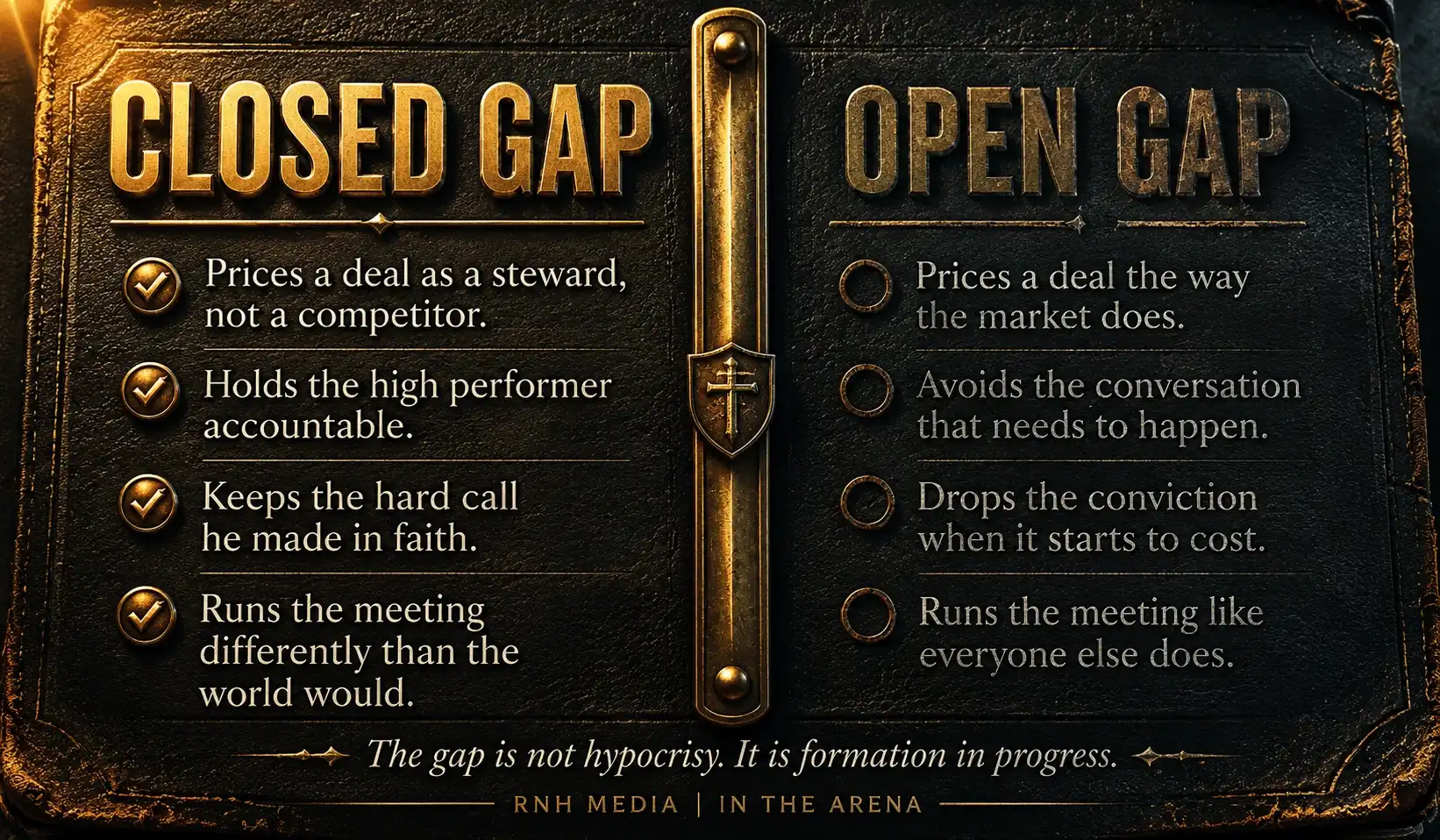
Closed gap: Values written and used in real decisions. A person with standing to confront you. A method for hard calls you use under pressure. You can explain Monday from the front of a room.
Open gap: Values felt but never specified. No one is positioned to say the hard thing. A method that evaporates when stakes rise. You hope Monday never comes up on Sunday.
Most leaders sit somewhere between the two columns. The comparison is not a diagnosis; it is a mirror.
How Do You Close the Sunday-Monday Gap?
You do not close the gap with more belief. You close it by building the three things most leaders are missing.
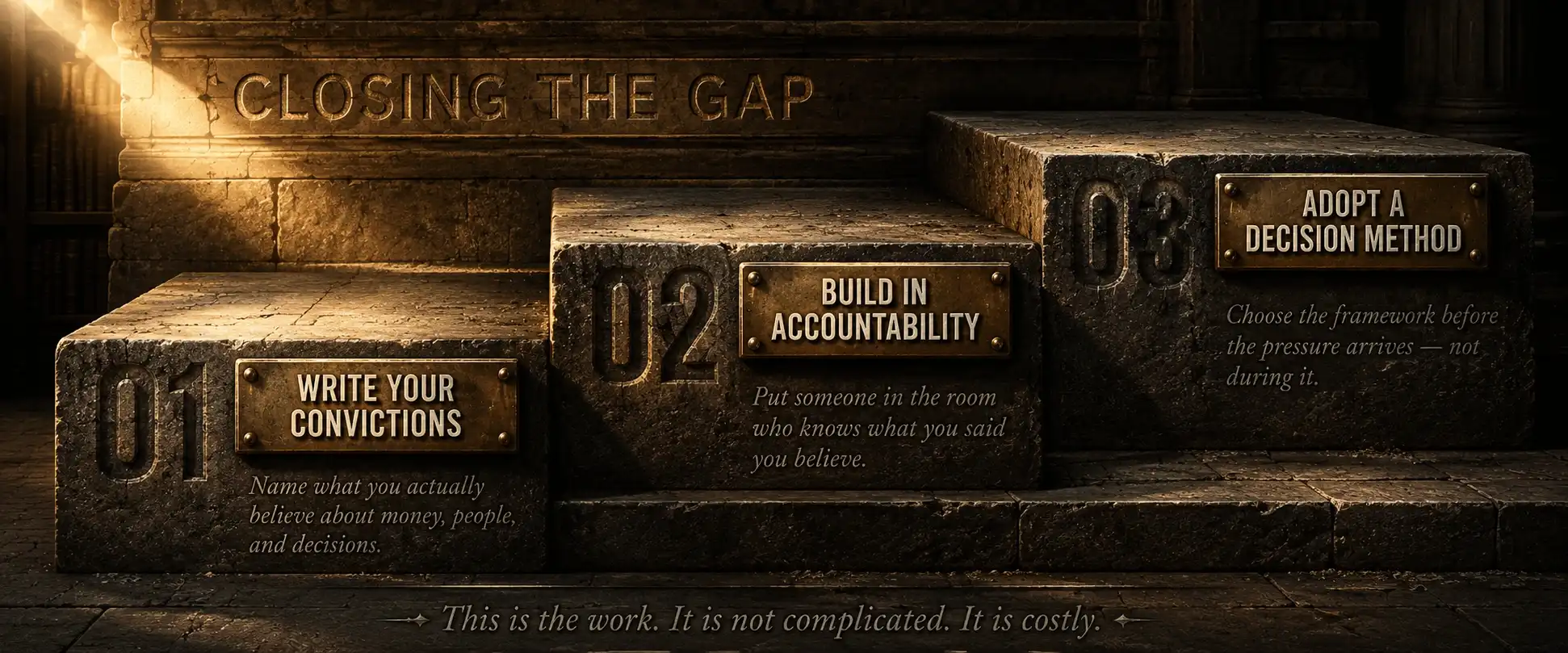
1. Define Your Operating Convictions in Writing
Take your core theological convictions and translate them into concrete operating statements, specific enough to govern real decisions. Not "we value integrity" but "we will not misrepresent numbers to close a deal." Not "we care about people" but "we will confront high performers who violate our values, even at a cost to revenue."
Written convictions do two things that an internal sense of right and wrong cannot: they survive pressure, and they give someone else something to hold you to.
2. Put Yourself Under Genuine Accountability
Create a relationship, or a small circle, where someone can see your decisions, not just your intentions, and has explicit permission to challenge them. This might be a board chair, a peer CEO group, or a mentor with both access and authority. The critical word is standing. Opinion without standing is noise. What closes the gap is a person who can say the hard thing and be heard.
3. Adopt a Method for Hard Calls That Survives Pressure
Use a decision framework that forces you to bring conviction, counsel, Scripture, and consequences into the same room before you act. The key is that this method must still be usable when you are tired, angry, or afraid, because adrenaline would otherwise decide for you. A method you only use in calm moments is not a method; it is a preference.
This is the kind of work we build for leaders at RNH Media. The Drift Diagnostic locates the gap. The 7F Framework gives the structure to close it. The work is not heroic. It is repeatable. If you want to go deeper, it is all in In The Arena.
Frequently Asked Questions
Who coined the term Sunday-Monday Gap?
The phrase has been used across faith-and-work writing for years to describe the disconnect between worship and the workweek. RNH Media defines it specifically as the operational distance between a leader's convictions and his decisions under pressure. It treats it as a diagnosable, closable problem rather than a vague lament.
Is the Sunday-Monday Gap the same as work-life balance?
No. Work-life balance is about time allocation. The Sunday-Monday Gap is about the integrity of conviction: whether what you believe actually governs what you decide. A leader can have excellent balance and a wide gap, or poor balance and a narrow one. They measure different things entirely.
Can the gap ever be fully closed?
Not permanently. Conviction and behavior drift apart whenever pressure rises, and the process is absent. The goal is not a permanent fix but a permanent practice: a repeating loop of defining convictions, submitting to accountability, and using a decision method that holds under load. The leader who closes the gap is not the one who finally gets it right; he is the one who keeps returning to the process.
What is the first step to closing my own gap?
Take a specific decision from the past week and run it through three questions: what you said you believe, what you actually did, and what any divergence cost. That single honest pass usually locates the gap faster than any formal assessment. Start with one decision. Be honest about what you find.
Is leadership drift the same as the Sunday-Monday Gap?
They are related but not identical. Leadership drift is the broader pattern of a leader moving away from his stated convictions over time. The Sunday-Monday Gap is one of the primary mechanisms through which drift happens. Drift is the destination; the gap is the road that gets you there.
Who is this content for?
Christian CEOs, founders, operators, and executives who take their faith seriously but have noticed a distance between what they believe and how they actually lead under pressure. If you have ever walked out of a hard meeting and felt like a stranger to yourself, this work is for you.
Last reviewed: May 2026.