

Pour the coffee, hit play, and come back to the article when you're ready. 👇

The Question Most Leaders Ask First
A leader stands in front of a decision. Hire him or pass on him. Take the deal or walk away. Move the family or stay. Take the call or refuse. Launch the product or kill it. Stay in this season of work or change seasons.
Most leaders ask one question first.
What is the best move?
"Best" is doing all the work in the sentence. Best by what standard? Most often, best means: highest expected value, lowest risk, most upside, fastest return, cleanest path. It is an optimization question. It treats the leader as a sophisticated decision-maker whose job is to maximize outcomes.
There is a different first question. It is the question Christian leaders rarely ask before they ask the optimization question.
What is the obedient move?
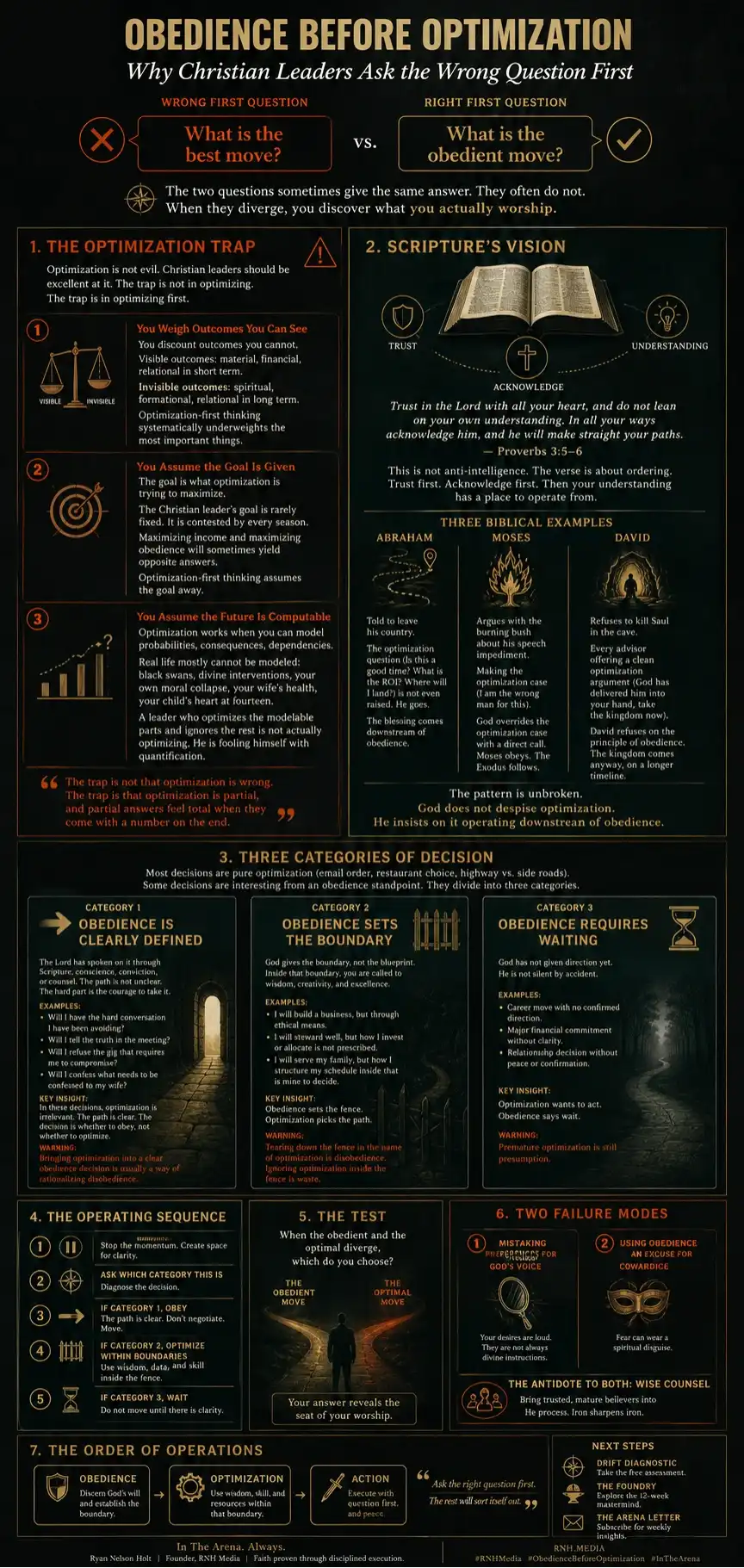
The two questions sometimes give the same answer. They often do not. When they diverge, you discover what you actually worship.
This guide is about asking the obedient question first, and only then the optimization question, and how to do that without becoming useless at making decisions.
The Optimization Trap
Optimization is not evil. Christian leaders should be excellent at it. Wisdom literature is full of optimization. The Proverbs are not about being a moral simpleton. They are about how to think clearly, weigh costs, make good choices, and avoid foolishness.
The trap is not in optimizing. The trap is in optimizing first.
When optimization is your first question, several things happen.
You weigh outcomes you can see. You discount outcomes you cannot. The visible outcomes are usually material, financial, or relational in the short term. The invisible outcomes are usually spiritual, formational, or relational in the long term. Optimization-first thinking systematically underweights the most important things.
You assume the goal is given. The goal is what optimization is trying to maximize. You take the goal as fixed and ask how to maximize it. The Christian leader's goal is rarely fixed. It is contested by every season of life. Maximizing; income and maximizingMaximizing obedience It assumes the goal away.
You assume the future is computable. Optimization works when you can model probabilities, consequences, and dependencies. Real life mostly cannot be modeled that way. Black swans, divine interventions, your own moral collapse, your wife's health, your child's heart at fourteen. None of these are in your spreadsheet. A leader who optimizes the modelable parts and ignores the rest is not actually optimizing. He is fooling himself with quantification.
The trap is not that optimization is wrong. The trap is that optimization is partial, and partial answers feel total when they come with a number on the end.
The Theology of Obedience
Scripture's vision of decision-making does not start with optimization. It starts with obedience.
Trust in the Lord with all your heart, and do not lean on your own understanding. In all your ways acknowledge him, and he will make straight your paths (Proverbs 3:5-6).
This is not anti-intelligence. The same Solomon wrote thousands of optimizations in the same book. The verse is about ordering. Trust first. Acknowledge first. Then your understanding has a place to operate from.
The model is repeated everywhere. Abraham is told to leave his country. The optimization question (Is this a good time? What is the ROI? Where will I land?) is not even raised. He goes. The blessing comes downstream of obedience.
Moses argues with the burning bush about his speech impediment. He is making the case for optimization (I am the wrong man for this; the case for optimization here is why). God overrides the optimization case with a direct call. Moses obeys. The Exodus follows.
David refuses to kill Saul in the cave when every advisor is offering him a clean optimization argument (God has delivered him into your hand, take the kingdom now). David refuses on the principle of obedience. The kingdom comes anyway, on a longer timeline, because David refused the shortcut.
The pattern is unbroken. God does not despise optimization. He insists on it operating downstream of obedience.
The Three Categories of Decision
Most decisions are not interesting from an obedience standpoint. What email should I reply to first? What restaurant should we eat at tonight? Should I take the highway or the side roads? These are pure optimization decisions. There is no obedience question hovering over them.
Some decisions are interesting from an obedience standpoint. They divide into three categories.
Category 1: Decisions where obedience is clearly defined
The Lord has spoken on it through Scripture, conscience, conviction, or counsel. The path is not unclear. The hard part is the courage to take it.
Examples: Will I have the hard conversation with the team member I have been avoiding? Will I tell the truth in the meeting? Will I refuse the gig that requires me to compromise? Will I confess what needs to be confessed to my wife?
In these decisions, optimization is irrelevant. The path is clear. The decision is whether to obey, not whether to optimize. Bringing optimization into a clear obedience decision is usually a sophisticated form of disobedience. You are looking for a respectable reason not to do the thing you already know God has asked you to do.
Category 2: Decisions where obedience sets the boundary, optimization makes the choice.
The Lord has not specified which option to take, but He has clearly marked some options as off-limits. Inside the remaining options, optimization is appropriate and necessary.
Examples: Choosing between two ethical job offers. Choosing how to deploy capital across legitimate uses. Choosing where to live among several morally neutral cities. Choosing who to hire among qualified, ethical candidates.
In these decisions, obedience sets the fence. Optimization picks the path inside the fence. This is the case for most decisions for most Christian leaders most of the time.
Category 3: Decisions where obedience requires waiting for Clarity
The Lord has not spoken yet, the path is not clear, and your responsibility is not to force a decision but to wait and watch.
Examples: A major life pivot you sense is coming but cannot yet see. A discernment about a calling that has not crystallized. A relationship decision where the picture is still developing. A business move where the timing is wrong but the direction is right.
In these decisions, optimization is a temptation. Optimization wants to act. Obedience says wait. The hardest thing for a leader to do is to obediently wait when his industry, his temperament, and his anxiety all want him to move now. Some of the costliest mistakes Christian leaders make are decisions they optimized into existence in a season the Lord was telling them to be still.
The first leadership skill is knowing which category a given decision falls into. The second is to act accordingly.

The Decision Framework
Here is the simple operating sequence I use.
Step 1: Pause
Before any meaningful decision, pause. Not five minutes. A day, if you can. A week, if it is large.
The pause is not laziness. It is the first act of obedience. You are saying: this decision is not mine to rush. I am giving God room to speak before I move.
A leader who cannot pause cannot obey. The urgency of his next move owns him.
Step 2: Ask which category this is
In the pause, ask: Is this a decision where the Lord has spoken? Where has he set boundaries? Where has he called for waiting?
You are not always sure. That is fine. Take your best read. Most of the time, the answer becomes clearer when you stop and ask.
Step 3: If Category 1, obey
If the path is clear, the only question is courage. Optimization will offer you twenty respectable reasons not to do the thing. Refuse them. Obey.
The cost of disobedience here is incalculable because it accrues invisibly. Every clear obedience refused makes the next clear obedience harder to perceive. Drift starts here.
Step 4: If Category 2, optimize within the boundaries
If obedience has set the fence and there are several options inside the fence, run a real optimization. Not a sloppy one. Make a model. Define your criteria. Weigh them. Score the options. Talk to wise counsel. Pray over it. Sleep on it. Then choose.
This is where Christian leaders should be excellent. Optimization, inside obedient boundaries, is wisdom—Solomon at his best.
Step 5: If Category 3, wait
Waiting is the hardest move. Most leaders cannot do it because their industry trains them to act under uncertainty as a virtue.
Waiting is not passive. It involves prayer, counsel, study, observation, and quiet readiness. You are not paralyzed. You are listening. The leader who can wait obediently in a season of uncertainty will, over a career, outperform the leader who cannot.
When the Clarity comes, you act fast. The waiting trained you to recognize the moment.
The Test of Whether You Are Doing This
There is a simple test for whether you are obeying first or optimizing first.
When the obedient and the optimal diverge, which do you choose?
If you can produce a recent example of choosing obedience over optimization at material cost to yourself, you are operating in the right order.
If every recent example you can produce had obedience and optimization conveniently aligned, that is not because the Lord is convenient. That is because you have been quietly editing the obedience question to match what you already wanted.
Most leaders, if they are honest, find they have been doing the second for a long time. The repair is to start asking the obedience question first, before the optimization question, on a small decision this week, and to follow it where it leads, even if it is unpopular or expensive.
Where This Goes Wrong
Two failure modes are common.
The first is mistaking your own preferences for God's voice. You want to do the thing. You spiritualize the wanting. You tell yourself God told you to do it when, in fact, you wanted to and grafted spiritual language onto the wanting. The corrective is wise counsel. Other men, especially older men in the faith, can tell you when your obedience case sounds suspiciously like your preference case in religious clothing.
The second is using obedience as an excuse for cowardice. You do not want to do something hard. You frame it as obedience to "wait." You are not waiting. You are hiding. The corrective is the same. Wise counsel. A trusted man who will tell you when your waiting is actually fear.
The community corrects both failures. A leader operating alone in his obedience-versus-optimization decisions will eventually rationalize his way somewhere unhealthy. A leader operating in a trusted community will get caught earlier.
The Closing Frame
The order of operations matters.
Obedience first. Then optimization. Then action.
Reverse the order, and you become a sophisticated leader who is slowly building a life God did not call you to. Most successful Christian leaders end up there if they are not careful, and the success papers over the misalignment until a season comes that strips the success and reveals what was underneath.
Get the order right. Most decisions are still optimization decisions, and you should be excellent at those. But the meaningful ones, the ones that shape your life, are obedience decisions first.
Ask the right question first. The rest will sort itself out, slower than you think, in a way that will hold up.
Next Steps
Take the Drift Diagnostic to see where optimization may have quietly outranked obedience in your recent season.
The Foundry is the cohort where leaders learn to think this way in real time. Apply at the next intake.
Subscribe to The Arena Letter for weekly notes from the field.
In The Arena. Always.