


On The Move?
You can listen to The Deep Dive below.

Why This Tool Exists
Most leaders do not fail.
They drift.
The failure narrative is the loud one: the blow-up affair, the public bankruptcy, the burnout breakdown. Failure is dramatic, and drama gets attention. But for every leader who blows up, there are a hundred who quietly drift, year after year, until one day they look around and realize they are nowhere near the man, the marriage, the body, the bank account, or the calling they thought they were building.
Drift is the more dangerous problem. You can recover from a failure because you can see it. You cannot recover from a drift you have not noticed, because there is nothing to recover from. You are just slowly becoming someone you would not respect.
The Drift Diagnostic exists to make drift visible.
This guide explains the diagnostic measures, how to interpret your results, and what to do next. If you have not taken it yet, you can do that here: drift.rnh.media. It takes five minutes.
The Core Premise
The diagnostic is built on a simple thesis: a leader's life is the sum of his stewardship across a small number of domains, and drift in any one domain compounds across all the others.
You cannot have a soaring spiritual life and a collapsing marriage. They will eventually collide. You cannot have an elite business and a body in free-fall. They will eventually collide. The domains are not silos. They are systems running in the same man.
Most assessments score one domain at a time. Personality tests score temperament. Fitness apps score sleep. Financial tools score net worth. Each tool is useful in isolation and useless in integration, because no leader actually lives in isolated domains.
The Drift Diagnostic scores the four most leveraged domains together, in a way that surfaces patterns you cannot see when you look at any one alone.
The Four Dimensions
The diagnostic measures four dimensions of drift. They are deliberately broad because drift is fractal. It shows up in small patterns before it shows up in big ones.
Dimension 1: Faith
Not church attendance. Not Bible knowledge. Not theological accuracy.
The diagnostic measures whether your operational life reflects the God you say you serve. Are you praying about decisions before you make them, or after? Is your work submitted to His Lordship, or is it a domain you have quietly carved out as your own? When did you last say no to something profitable because it would not honor Him?
A high faith score means low drift here. It does not mean you are spiritually mature. It means you are not running away from God in this season.
Dimension 2: Family
Not whether you love your family. Most men do.
The diagnostic measures whether your family is receiving the version of you that they need, in the time and attention that it requires. How present are you when you are home? When did you last have a substantive conversation with your wife that did not involve logistics? Do your kids see you under pressure, or only when things are easy?
A high family score means your family is not getting the leftover version of you. A low score means they are.
Dimension 3: Fitness
Not whether you are in elite shape.
The diagnostic measures whether your body is functioning as a vehicle for your calling or quietly degrading because of how you treat it. Are you sleeping enough? Are you eating like a man who plans to be useful at sixty? Are you moving every day? Are you on top of the medical conditions you have, or pretending they will sort themselves out?
A high fitness score means your body is not the bottleneck to your calling. A low score means it is becoming one.
Dimension 4: Focus
Not productivity in the sense of how much you can squeeze into a day.
The diagnostic measures whether you are doing the deep, hard, valuable work that only you can do, or whether your week is consumed by the easier work that anyone could do. Are you spending the bulk of your prime hours on your highest-leverage activities? Or are you spending them on email, meetings, and reactive low-stakes work, then telling yourself you are too busy to do the real thing?
A high focus score means you are spending your scarce capacity on what matters most. A low score means you are spending it on what is most available.
These four dimensions cover most of the drift territory for most leaders. The diagnostic intentionally does not cover everything. A diagnostic that covers everything covers nothing.
How the Scoring Works
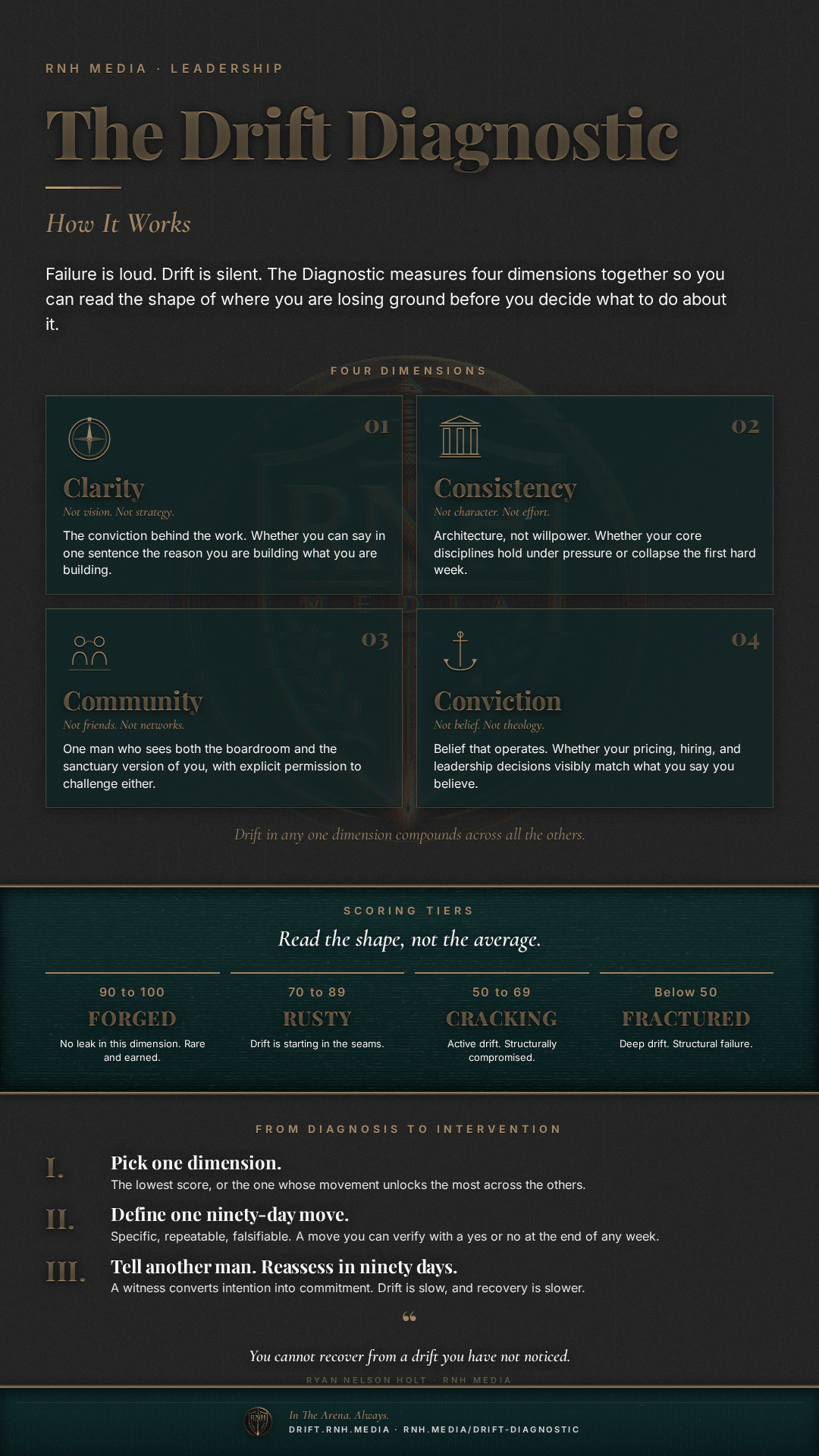
The assessment asks a small number of high-signal questions per dimension. Each question is answered on a four-point scale, deliberately without a neutral middle. You are forced to lean one direction or the other, because drift hides in the middle.
Each dimension produces a score from 1 to 100.
- 80 to 100: Strong stewardship in this dimension.
- 60 to 79: Watch list. Drift is starting.
- 40 to 59: Active drift. You are losing ground.
- Below 40: Crisis. This dimension needs intervention.
The composite score across all four dimensions matters less than the individual dimension scores. A man with a 65 average and four 65s is in a different shape than a man with a 65 average composed of an 85 in faith, an 85 in fitness, a 45 in family, and a 45 in focus. The first man is mid-fade across the board. The second man has a marriage and a calling problem.
You are reading the diagnostic for the gaps between dimensions.—theshape of the score, not the average.
What the Patterns Mean
Across the leaders who have taken the diagnostic, four patterns appear most often.
Pattern 1: The High-Faith, Low-Family Leader
This man is praying, reading, and serving. His marriage is brittle, and his kids are quietly disconnected. He thinks his spiritual life will fix his family. It will not, on its own. The remedy is repentance about the time, energy, and attention he has been calling "ministry" while neglecting the household God gave him to lead first.
Pattern 2: The High-Focus, Low-Fitness Leader
This man is killing it at work. He is also quietly killing himself. The body is being used like a furnace. Sleep is rationed. Movement is sporadic. Food is fuel for the next sprint. The remedy is to recognize that the body is not separate from the calling. It is the vehicle for it. A vehicle in disrepair will end the call clearly.
Pattern 3: The Low-Faith, High-Everything Else Leader
This man has built a high-performing life that has quietly cut God out. He is moral. He is productive. His family is doing well. He gives generously. But the operating center is no longer Christ. It is competence. The remedy is harder than it sounds because nothing is on fire. He has to choose to bring the center back, on purpose, before something forces him to.
Pattern 4: The Across-The-Board Mid-Fade
This is the most common result. No dimension is in crisis. None is strong. Everything is in the -55 to 0 range. This man is not failing. He is drifting. The remedy is the hardest of the four, because there is no obvious fire. He has to choose an intervention without an emergency, and most men will not do that until the emergency arrives.
If your result is the mid-fade, take it as a warning, not a relief. Mid-fade is the precursor to actual failure. The men who blow up at fifty almost always had mid-fade scores at forty.
How to Use the Results
The results are diagnostic, not prescriptive. They tell you where to look. They do not tell you what to do.
Here is how to use them in the next thirty days.
Step 1: Tell another man
Print or screenshot your results. Send them to one man you trust. Not your wife. Not your therapist. Not your pastor, unless your pastor knows your work and your weaknesses well. Another leader who will tell you the truth.
Ask him to read your scores and reflect on what he sees that you might be missing. You are not asking for a solution. You are asking for a second pair of eyes on a self-assessment that may be biased.
Step 2: Pick one dimension
Do not try to fix four dimensions at once. You will fix none.
Pick the lowest score, or the dimension where movement would unlock the most across the others. For most leaders, that second one is faith or family. Faith because it reorders everything. Family, because the relational pressure of a struggling home leaks into every other domain.
Step 3: Define a ninety-day move
In the dimension you picked, define one specific move you will make in the next ninety days. Not a goal. A move.
Not "improve my marriage." That is not a move. That is a category.
A move sounds like: Every Friday at 7 p.m., my wife and I will have a 60-minute conversation that is not about logistics. I will plan the. I will not check my phone. I will do this for thirteen weeks straight, and then we will assess.
That is a move. It is specific, repeatable, and falsifiable.
Step 4: Tell your wife or your closest accountability partner
Tell one person what the move is. Not for their permission. For their witness. The presence of a witness is what converts intention into commitment.
Step 5: Reassess in ninety days
Take the diagnostic again at ninety days. Not before. Drift is slow. Recovery is slower. You will not see major movement in two weeks. You will see it in twelve.
If your move worked, the score will reflect it. If it did not, the score will tell you that too. Either way, you norather thana instead of feelings, and you can adjust accordingly.
What This Tool Is Not
The Drift Diagnostic is not therapy. It is not pastoral care. It is not a substitute for the real work of confession, community, and formation that closes drift over time.
It is a five-minute mirror.
A mirror cannot fix you. It can only show you what is there. The fixing is your work, with God, with your wife, with your trusted men.
Use the mirror. Then put it down and go to work.
A Final Word
If your diagnostic score made you uncomfortable, that is the diagnostic working. Discomfort is the precondition of repair. A score that did not make you flinch is either a great score or a dishonest one. Most are dishonest.
If your score made you defensive, sit with that. Defensiveness in a self-assessment is information. It usually points to the dimension where the real work is.
If your score did not prompt you to take any action in the next 30 days, the tool was useless. Diagnosis without intervention is just spiritual entertainment.
Take it. Read it. Pick a move. Make it.
Then come back in ninety days and see what changed.
Take the Diagnostic
Take the Drift Diagnostic: free, five minutes, no email gate to start.
The Foundry is the next step for leaders ready to do this work in a structured cohort.
Subscribe to The Arena Letter for weekly notes on leading without drifting.
In The Arena. Always.
Ryan Nelson Holt
Leading, Building, and Fighting The Good Fight.