


Deep Dive Podcast
Start here if you want the fuller conversation behind this piece. The article gives you the framework. The audio gives you the texture, emphasis, and reasoning underneath it.

Real accountability is a relationship where another man knows the truth about your life, has the authority to press into it, and carries real consequences you agreed to in advance if you drift. It closes the Sunday–Monday Gap not with talk, but with structure that actually changes how you live.
Real accountability is the kind that actually changes a man, not the kind that performs concern and changes nothing. It matters to any Christian leader who has a guy and a weekly check-in but keeps naming the same patterns year after year. Please skip the real thing, and you will mistake friendly conversation for formation until the bill comes due.
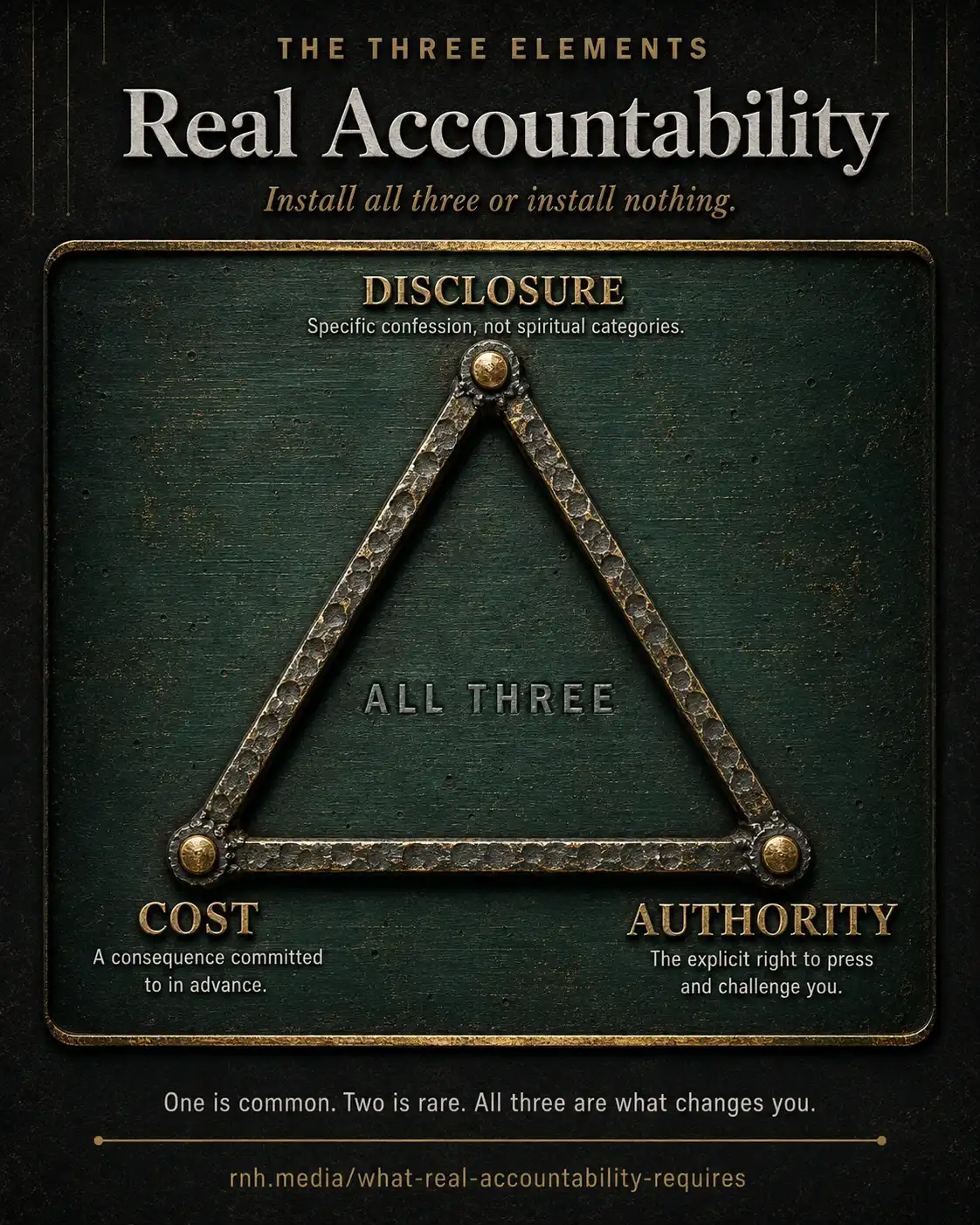
Here is the short answer. Real accountability requires three elements that almost no arrangement installs together: real disclosure, which is specific confession rather than spiritual categories; real authority, which is the explicit right you give another man to press and challenge you; and real cost, which is a consequence committed to in advance for non-compliance. One of the three is common. Two is rare. All three are what changes you.
This is a field guide to the three elements, why they are rare, and how to install them if you are tired of the theatre.
Why Most Accountability Is Theatre
Most Christian men have been in some version of an accountability relationship. A weekly check-in. A standard list of questions. How was your week? Any struggles. Any temptations. Two men sit across from each other, perform the ritual, go home, and change nothing.
The ritual is not useless. It is mostly theatre. It produces the appearance of accountability without the substance. Accountability drifts soft for four predictable reasons.
The first is the social contract of niceness. Christian men are trained to be polite with each other. The polite man does not press. He accepts the surface answer and moves on. Accountability bound by politeness is structurally incapable of doing its job.
The second is asymmetry. The man holding you accountable often has things in his own life he does not want examined. Pressing you would invite pressing him, so a tacit treaty forms. I will not see deeply if you will not see deeply. The treaty protects both parties from each other.
The third is structural drift. The relationship was set up under one set of conditions, and the conditions changed. New jobs, new schedules, new seasons. It was never re-grounded, so it coasts on inertia until it is mostly fellowship and only nominally accountability.
The fourth is the absence of teeth. Accountability without consequences is a journal entry. Nobody is going to do anything if you do not change, so you do not change.
You can install accountability that addresses all four. It is uncomfortable to build, costly to maintain, and it changes you if you do.
What Is Real Disclosure?
Real accountability requires real disclosure. That sounds obvious. Almost no man practices it.
Most accountability runs on managed disclosure. You have shared enough to maintain your credibility, and you are holding back what would cost you to admit. You confess “lust” instead of the specific incident. You confess “pride” instead of the specific moment. You say the week was “hard” instead of naming the specific way it broke you.
Real disclosure is specific. Specific is the difference between “I struggled with anger this week” and “On Tuesday afternoon I yelled at my eight-year-old over a cup of spilled milk in a way that scared him, and I have not made it right yet.” Same category. Profoundly different disclosure.
Real disclosure asks three things of you. The willingness to be specific about what actually happened, not just the category it fits. The willingness to be specific about your part, not just the situation. “He provoked me” is not disclosure. “I chose contempt because I wanted to win” is. And the willingness to bring the things you most want to keep hidden. The accountability that excludes those is not accountability. It is selective fellowship.
“Confess your sins to one another and pray for one another, that you may be healed” (James 5:16). You will not get real disclosure from another man until you give it first. If you wait for him to go first, you will be waiting a long time, and so will he.
What Is Real Authority?
Real accountability requires that the other man have actual authority in your life. Authority does not mean dictatorial control. It means the right to speak hard things and have them weigh, to ask uncomfortable questions and have them answered, to challenge a course of action and have you take it seriously.
Most accountability relationships have no authority. The partner can ask anything, and you can dismiss anything. He has no standing to keep pressing once you politely brush him off. Authority is given, not assumed. You give it by saying, in advance and explicitly, what kind of authority he has. It sounds like this.
I am asking you to have the kind of authority in my life that lets you challenge my decisions, my patterns, and my evasions. If I tell you I am fine and you do not believe me, keep pressing. If I am about to make a major decision, you have the right to call it into question. If you see something in me that needs naming, name it. I am not committing to obey you. I am committing to take you seriously and engage in good faith.
That conversation converts a fellowship into an accountability. Without it you have a friend. With it you have something more useful.
Choose the man carefully. Three criteria. He should be further along than you in the specific area where you are weakest, not in general. If your accountability partner’s marriage is also fragile, your marriage accountability will not hold. He should be willing to receive authority back, because reciprocity is the structural protection against the asymmetry trap. And he should have no stake in your outcomes: he should not work for you, employ you, or be financially entangled with you. Authority contaminated by financial dependency is compromised before it starts.
“Iron sharpens iron, and one man sharpens another” (Proverbs 27:17). If you cannot find that man inside your current circle, look outside it. He is rarer than you think and easier to find than you assume.
What Is Real Cost
Real accountability requires real cost for non-compliance. This is the element nobody wants to install, because it forecloses on the comfortable possibility that you can have accountability and also keep doing whatever you want.
Cost can take several forms. It can be relational: tell your partner that if you fail to address a pattern within a defined timeline, he is to bring your wife into the conversation. Most patterns resolve quietly at the threat of that conversation, because the cost is finally proportional to the issue. It can be financial: you commit to give a sum that makes you wince to a cause you do not love if you violate a defined commitment. Twenty dollars is not enough. The sum has to sting. It can be confessional: you commit in advance that if a pattern continues, you will widen the circle, to your pastor, your elders, your business partner, your wife if she does not already know. And in a few severe cases it can be vocational: you step away from a position of leadership if the pattern persists.
The exact form matters less than the existence of one. Accountability without cost is a habit. Accountability with cost is a structure. You install the cost in advance, before the temptation arrives, so the future version of you cannot rationalize his way out of it in the moment.
What The Three Elements Produce Together
Disclosure. Authority. Cost. Install all three and the dynamics change.
You stop being able to skim. The relationship insists on substance, and you will sometimes resent it. That is part of the design. The version of you that resents real accountability is the version that needs it most.
The other man changes too. He stops performing concern and starts holding the line with you. He grows in his ability to ask hard questions, sit with the answers, and follow up. “Faithful are the wounds of a friend” (Proverbs 27:6). The relationship deepens because it has finally become a real one.
Over time, the patterns actually shift. Not always quickly, not always cleanly, but in a way surface accountability never produced, because the structure now has the teeth it always lacked. “Exhort one another every day, that none of you may be hardened by the deceitfulness of sin” (Hebrews 3:13).
What Real Accountability Is Not
Real accountability is not heavy-handed legalism. It is not a man scolding you weekly for your failures. It is not a relationship where you live anxious about being caught. And it is not a substitute for grace, for the Spirit’s work, for community, for confession to your wife, or for pastoral care.
It is one component of the Christian life, alongside the others. “If anyone is caught in any transgression, you who are spiritual should restore him in a spirit of gentleness” (Galatians 6:1). A leader with real accountability and no grace becomes legalistic and brittle. A leader with grace and no real accountability becomes vague and drifts. The two are companions, not alternatives.
How To Install Real Accountability
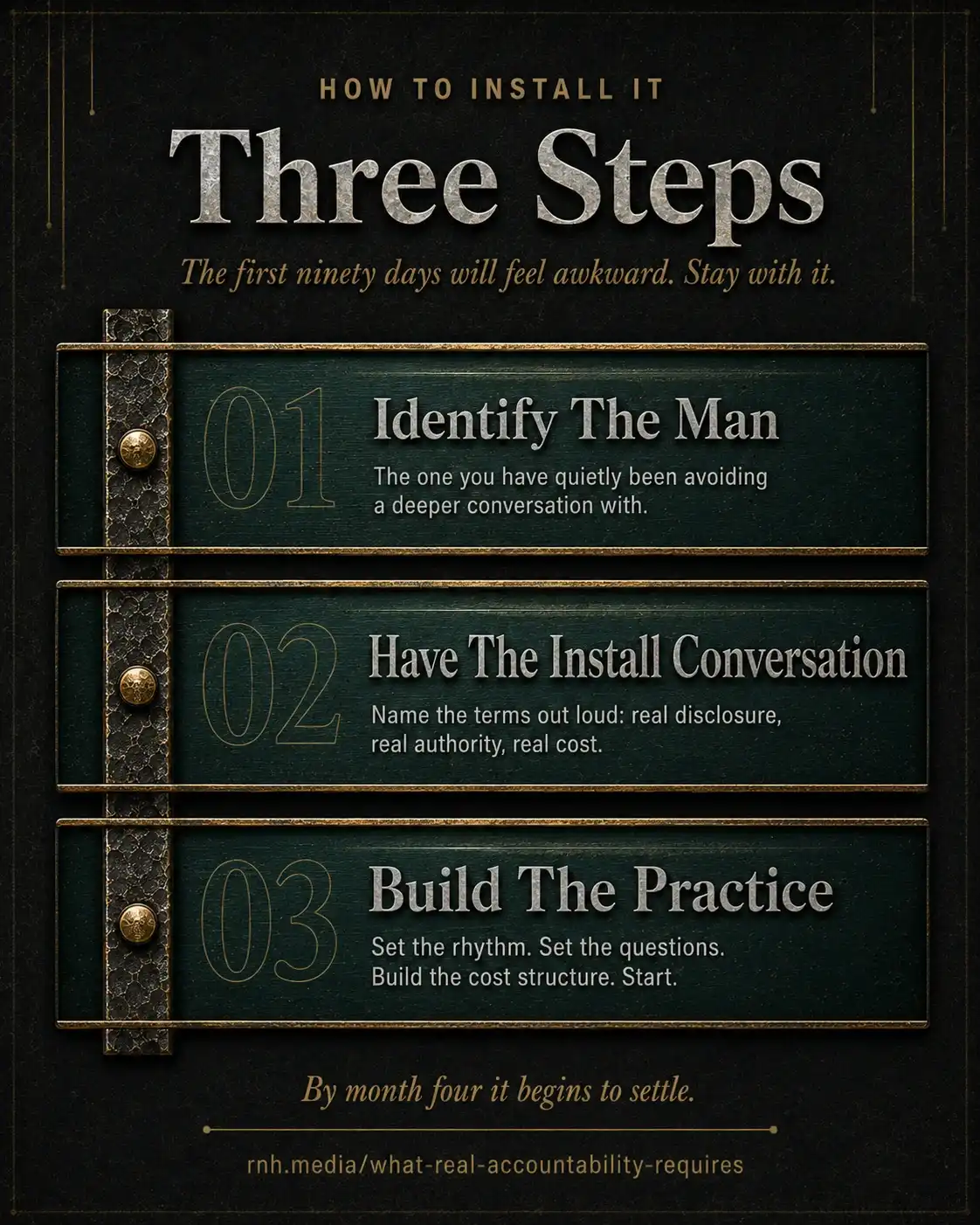
Three steps.
Step 1: Identify The Man
You probably already know who he is. He is the one you have quietly been avoiding a deeper conversation with, because you sense it would cost you. Pay attention to that signal. The right man is often the one your defenses have flagged as too risky. If you cannot find him in your current circle, broaden the search: older men in your church, mentors from earlier seasons, men in your industry who share your faith and have integrity, or men in a structured cohort like The Foundry, where the soil is already prepared.
Step 2: Have The Install Conversation
Tell him directly. “I do not want a casual accountability relationship. I want one with real disclosure, real authority, and real cost. I am asking whether you would be willing to be that man in my life, and I am willing to be that man for you in return.” That conversation is the install. After it, you have either started the work or ruled out that man.
Step 3: Build The Practice
Set the rhythm. Set the questions. Build the cost structure. Start. The first ninety days will feel awkward, because the relationship does not yet have the trust the practice requires. Stay with it. By month four it begins to settle. By the end of year one it will be the most useful relationship in your life.
Frequently Asked Questions
What is real accountability?
Real accountability is a relationship built on three elements installed together: real disclosure (specific confession, not spiritual categories), real authority (the explicit right you give another man to press and challenge you), and real cost (a consequence committed to in advance for non-compliance). Most arrangements have one. All three are what actually change a man.
Why does most accountability fail?
It goes soft for four reasons: the social contract of niceness, where polite men do not press; asymmetry, where neither man wants to be examined; structural drift, where the relationship is never re-grounded as life changes; and the absence of teeth, since accountability without consequences is just a journal entry that changes nothing.
How do I choose an accountability partner?r
Pick a man who is further along than you in the specific area where you are weakest, who is willing to receive the same authority back, and who has no financial stake in your outcomes. He should not work for you or be financially entangled with you. Authority contaminated by financial dependency is compromised before it starts.
What does real cost in accountability look like?
Cost is a consequence you commit to before temptation arrives. It can be relational, such as your partner bringing your wife into the conversation if a pattern persists; financial, a sum large enough to sting given to a cause you dislike; confessional, widening the circle to a pastor or elders; or vocational, stepping away from a role. The form matters less than the fact that one exists.
Is accountability the same as legalism?
No. Real accountability is not weekly scolding or living anxious about being caught, and it never replaces grace, the Spirit’s work, community, or pastoral care. It is one component of the Christian life. A leader with accountability and no grace turns brittle. A leader with grace and no accountability drifts. The two are companions, not alternatives.
Next Steps In The Arena
Most leaders are coasting on accountability theatre and calling it accountability. Find out where it has been quietly hiding drift.
Step 1 is to Name the Drift. Please take The Drift Diagnostic. Five minutes. Zero cost. You will walk away with an honest read on where you are losing ground.
Step 2 is to Build the Structure. The Foundry is the membership where this kind of accountability gets built with structure, brotherhood, and the conviction t
hat leaders are forged, not fixed.
Step 3 is to Stay in the fight. Subscribe to The Arena Letter for a Monday note from the field, so your week starts with Clarity rather than drift. In the arena, the man who invites real accountability is the man who keeps standing.