
Prefer to listen?
Hear a full discussion of the Sunday-Monday Gap and how to close it, below.
The one idea from this article is worth carrying into your week.

You sang worship songs with conviction on Sunday morning. By Monday afternoon, you made a business decision without a single thought of the God you praised twenty-four hours earlier.
You are not alone. And you are not a hypocrite. You are fragmented.
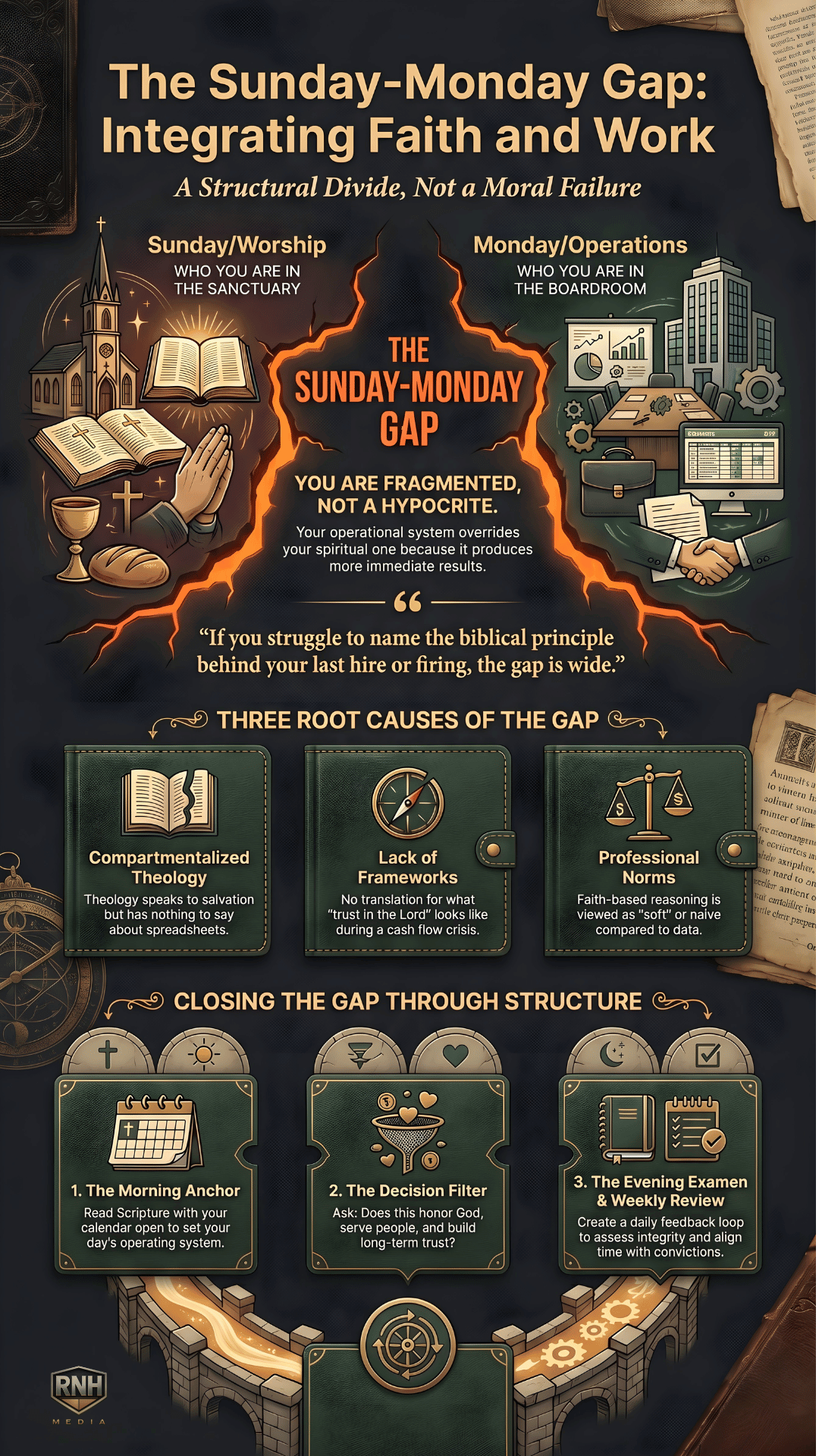
The Sunday-Monday Gap is the most common and least discussed crisis in faith-driven leadership. It is the disconnect between the man you are in the sanctuary and the man you are in the boardroom. It is not a moral failure. It is a structural one. And until you address the structure, no amount of devotional reading will close it.
Defining the Gap
The Sunday-Monday Gap is not about whether you pray at work or keep a Bible on your desk. It is about whether your faith actually informs your operational decisions or merely decorates them.
Here is the test: Think about the last significant business decision you made. A hire. A firing. A pricing change. A partnership. How explicitly did your faith inform that decision? Not in a vague 'I prayed about it' sense, but in a concrete 'this biblical principle shaped my reasoning' way.
If you struggle to answer that, the gap is wider than you think.
The gap manifests in predictable patterns. You operate with one set of values in church contexts and another in business. You apply biblical ethics to personal relationships but revert to purely pragmatic reasoning in professional ones. You think of faith as something you practice in the morning and business as something you practice the rest of the day.
This fragmentation is exhausting. You are running two operating systems simultaneously. Eventually, one wins. In most cases, the operational system overrides the spiritual one because it produces more immediate, measurable results.
Why the Gap Exists
1. Compartmentalized Theology
Most men learned their faith in contexts separated from work. Church on Sunday. Business on Monday. Different domains, different rules. The result is a theology that speaks to personal salvation but has little to say about spreadsheets, difficult employees, or market strategy.
2. No Practical Framework
Even men who want to integrate lack a practical framework for doing so. What does 'love your neighbor' look like when you need to lay off fifteen people? What does 'trust in the Lord' mean when cash flow is tight, and payroll is due Friday? Without frameworks that translate theology into operations, the gap persists.
3. Professional Norms
The business world has its own orthodoxy. Data-driven decisions. Competitive advantage. Shareholder value. These create a culture where faith-based reasoning is seen as soft or naive. Men learn to leave their faith at the office door because the professional cost of integration feels too high.
Four Practices That Close the Gap
Practice 1: The Morning Anchor
Before you open your email, open Scripture. Not as a religious ritual. As a strategic act. You are setting the operating system for the day. Five minutes of intentional reading, focused on one passage, with one question: How does this truth apply to what I will face today?
This is not about reading more Bible. It is about reading the Bible with your calendar open beside it and making the connection between Sunday's truth and Monday's task explicit and unavoidable.
Practice 2: The Decision Filter
Before every significant decision, run it through three questions: Does this honor God? Does this serve the people involved? Does this build long-term trust?
The filter does not make decisions easy. It makes them clear. Sometimes the right answer is painful. Closing the gap does not mean every decision feels good. It means every decision is made with integrity intact.
Practice 3: The Evening Examen
Borrowed from the Ignatian tradition and adapted for the marketplace: at the end of each workday, spend five minutes asking two questions. Where did I lead with integrity today? Where did I operate out of fear, self-interest, or convenience?
This practice creates a daily feedback loop. It prevents the slow drift that occurs when you never pause to assess whether you're with your convictions.
Practice 4: The Weekly Review
Once per week, review your calendar, your decisions, and your interactions through the lens of the 7F Framework. Were your priorities aligned with your values? Did your time allocation reflect your stated convictions? Where did the gap appear, and what structural change would prevent it?
Integration Is Not Perfection
Closing the Sunday-Monday Gap does not mean you will never fail. It means you will notice when you do. It means the gap stops growing because you have structures in place to catch it.
Integration is a practice, not a destination. You will never arrive at a place where faith and work are perfectly fused. But you can build a life where the distance between them shrinks consistently, where the man in the sanctuary and the man in the boardroom are recognizably the same person.
The Theological Foundation
"Whatever you do, work heartily, as for the Lord and not for men, knowing that from the Lord you will receive the inheritance as your reward. You are serving the Lord Christ." (Colossians 3:23-24, ESV)
Paul did not write this to pastors. He wrote it to the others. The theological foundation for closing the gap is not a new insight. It is a forgotten one. Work is worship when it is done with awareness of the One you ultimately serve.
This does not mean plastering Bible verses on your office wall. It means allowing the reality of God's presence to inform how you treat your team, how you handle conflict, how you price your services, and your decisions when no one is watching.
Your Next Step
Start with the Morning Anchor tomorrow. Five minutes. One passage. One question: How does this apply to what I face today?
Do it for one week. Then add the Decision Filter. Build the practices one at a time, and the gap will close not through effort but through structure.
Subscribe to the RNH Media newsletter for a weekly letter designed to bridge the gap before the week begins.
In the arena. Always.
Ryan Nelson Holt | Founder, RNH Media
In The Arena: Leading, Building, and Fighting The Good Fight