


Prefer to listen?
Hear a Deep Dive into this article here.
Nobody wakes up one morning and decides to fail.
Nobody sits down at their desk and thinks, 'Today I will begin the slow process of abandoning everything I said mattered to me.' It does not work that way. Failure, for leaders, is rarely a single catastrophic event. It is a series of small concessions, invisible compromises, and gradual departures from the convictions that once defined them.
That is drift.
Drift is the most dangerous threat to your leadership, your family, and your faith precisely because you do not feel it happening. It is the current that pulls you off course while you are still paddling. By the time you notice, you are miles from where you intended to be.
This guide exists to help you identify drift, understand why it happens, and build the structures that prevent it from taking root in your life.
What Drift Actually Is
Drift is the slow, imperceptible erosion of your standards, disciplines, and convictions. It is not rebellion. Rebellion is obvious. Drift is subtle. Rebellion announces itself. Drift whispers.
Drift looks like skipping your morning Bible reading because the day started early, and then skipping it again because yesterday was fine without it, and then realizing three months later that you cannot remember the last time you opened Scripture outside of Sunday.
Drift looks like saying yes to one more commitment because it seems important, then another, until you find yourself so overextended that you have no margin for the things you claim are most important.
Drift looks like lowering your hiring standards because you need someone now. Or accepting mediocre work from your team because the conversation required to address it feels exhausting. Or letting your health slide because the business needs you more than the gym does.
In every case, the individual decision seems small. Reasonable, even. But drift operates on compound interest. Small departures, compounded daily, produce massive distances over time.
Why Leaders Are Uniquely Vulnerable
Leaders drift because leadership creates the very conditions in which drift thrives.
First, leaders are busy. Busyness creates the illusion of progress. If you are working fourteen hours a day, it feels like you must be moving forward. But activity is not direction. You can be busy and drifting simultaneously. In fact, busyness is often the mechanism of drift. It keeps you so occupied that you don't notice the erosion.
Second, leaders are isolated. The higher you climb, the fewer people are willing to tell you the truth. Your team needs you to be strong. Your family needs you to be present. Nobody wants to be the one who says, 'I think you are losing your way.' So they stay silent, and you stay drifting.
Third, leaders are competent. Competence is the enemy of dependence. When you are good at what you do, it becomes easy to operate on talent instead of conviction. You can lead effectively for years on pure skill while your spiritual foundation quietly erodes. The results keep coming. The fruit looks good. But the root system is dying.
"Therefore, we must pay much closer attention to what we have heard, lest we drift away from it." (Hebrews 2:1, ESV)
The Five Domains of Drift
Drift does not attack one area of your life. It attacks all of them, often starting in the area you neglect most.
1. Spiritual Drift
This is the departure from practiced dependence on God. Your prayer life becomes performative or disappears entirely. Scripture reading becomes sporadic. You begin making decisions based on market data and gut instinct without ever consulting the One who holds your future.
The warning sign: You cannot identify a specific time in the last week when you heard from God.
2. Relational Drift
Your closest relationships become transactional. Your marriage operates on logistics. Your friendships become networking. You have hundreds of contacts and zero brothers.
The warning sign: The people closest to you would describe you as 'busy' before they would describe you as 'present.'
3. Physical Drift
You stop stewarding your body. Sleep becomes a luxury you borrow against. Exercise becomes something you will get back to next week. Nutrition becomes whatever is fastest.
The warning sign: Your energy is consistently low, and you are relying on caffeine and adrenaline to function.
4. Vocational Drift
Your work loses its connection to calling. You are no longer building something that matters. You are maintaining something that pays. The vision that launched the business has faded into the daily grind of operations.
The warning sign: You cannot articulate why you do what you do without referencing money.
5. Intellectual Drift
You stop learning. You stop reading. You stop engaging with ideas that challenge your assumptions. You begin operating on autopilot, recycling the same strategies and frameworks that worked five years ago.
The warning sign: The last book that genuinely changed your thinking was more than a year ago.
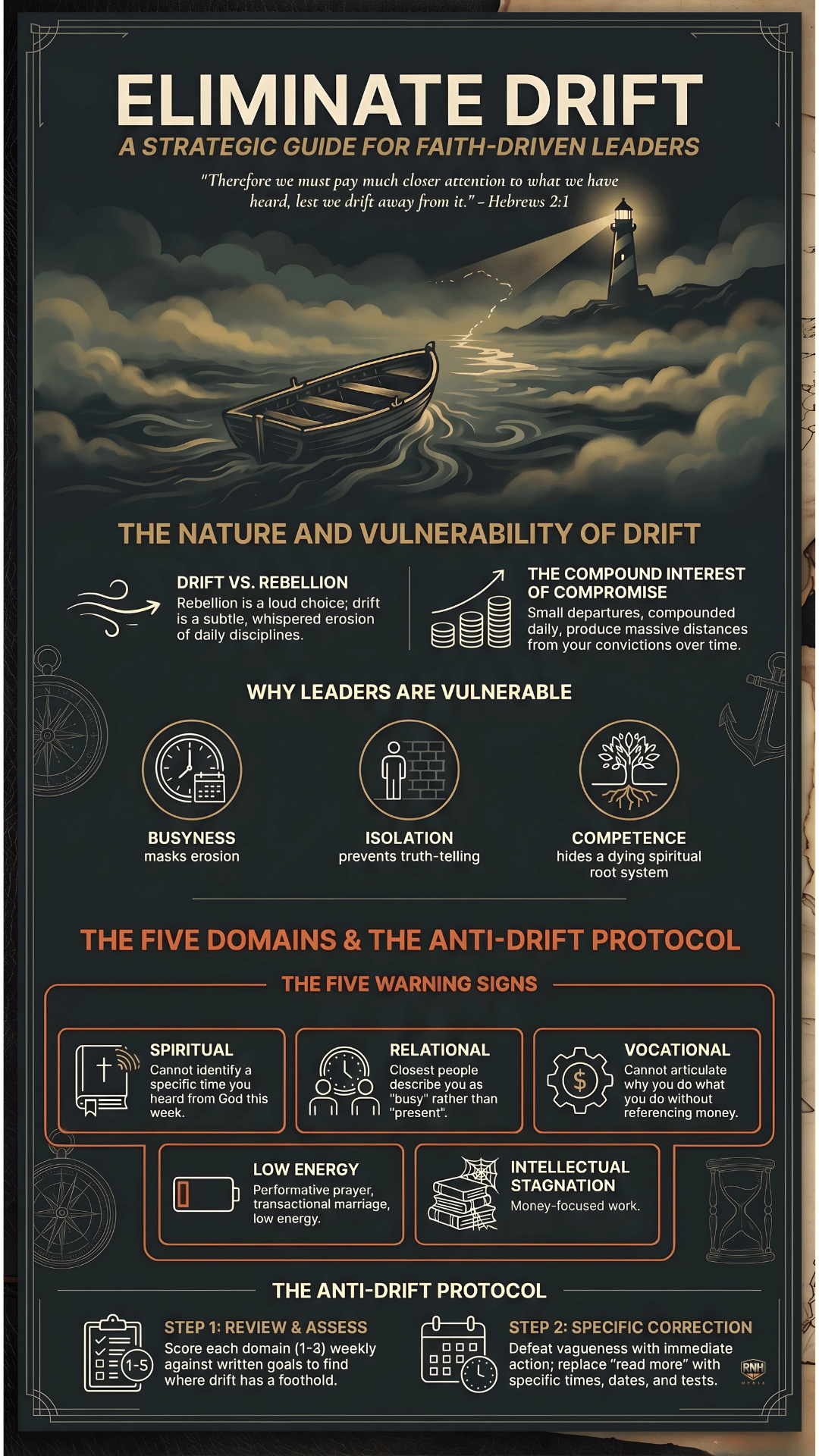
Drift rarely announces itself. These five warning signs reveal where erosion has taken hold — and the Anti-Drift Protocol is how you correct course.The Anti-Drift Protocol
Drift is not eliminated by willpower. It is eliminated by structure. The Anti-Drift Protocol is a weekly practice that takes fifteen minutes and prevents the slow erosion that destroys leaders.
Step 1: Review
What did I commit to this week? Not what happened to me. What did I set out to do? This requires written goals. If your intentions live only in your head, you have no benchmark against which to measure drift. Write down your commitments for the week. Then, at the end of the week, review them honestly.
Step 2: Assess
Where am I actually? Not where do I want to be. Not where do I tell people I am. Where am I actually? This requires brutal honesty. Score each of the five domains on a scale of 1 to 5. If you cannot give yourself a 4 or above, drift has found a foothold.
Step 3: Correct
What must change this week? Not this month. Not this quarter. This week. Drift is reversed with immediate, specific action. If you have drifted spiritually, the correction is not 'read the Bible more.' The correction is 'Read Proverbs 3 tomorrow at 6:00 AM before opening email.' Specificity defeats drift. Vagueness feeds it.
Building Drift-Proof Structures
The Anti-Drift Protocol is the weekly tool. But preventing drift long-term requires permanent structures in your life.
First, you need accountability. Not the casual kind where a friend asks 'how are you doing?' and you say 'fine.' Structured accountability with someone who has permission to ask hard questions and the integrity to press when your answers are vague. This is what the Redemption Mastermind provides: a cohort of men who will not let you drift unnoticed.
Second, you need rhythm. A predictable weekly structure that anchors your priorities regardless of what chaos the week brings. A non-negotiable morning practice. A weekly review. A quarterly audit. These rhythms create guardrails against drift.
Third, you need vision—a clear, written, regularly reviewed picture of where you are going and why it matters. Vision is the lighthouse that makes the rift visible. Without it, you have no reference point. Every direction looks the same.
The Cost of Ignoring Drift
I have seen leaders lose their marriages due to drift. Not to affairs. Not too dramatic a conflict. To the slow, invisible erosion of presence and priority that left their spouse feeling like a roommate.
I have seen leaders lose their health to drift. Not to a sudden diagnosis. Two years of neglect compounded into a crisis.
I have seen leaders lose their faith and drift. Not to a theological crisis. To the gradual replacement of dependence on God with dependence on their own competence.
Drift does not announce itself. That is what makes it deadly. And that is why you cannot afford to ignore it.

Your Next Step
Start this week. Not next Monday. This week.
Take fifteen minutes. Score each of the five domains. Be honest. Then identify one specific correction you will make before the week ends.
If you want weekly content designed to keep you sharp, accountable, and drift-proof, subscribe to the RNH Media newsletter. Every Monday, I share the lessons I am learning as I fight drift in my own life. No hype. No theory. Just one leader telling another leader the truth.
Drift is optional. Discipline is a choice. Choose well.
In the arena. Always.
_______________________________________________
Ryan Nelson Holt | Founder, RNH Media
In The Arena: Leading, Building, and Fighting The Good Fight
RNH.MEDIA