

Prefer to listen?
This article is available as a full deep-dive conversation. Hit play below, or keep reading.

Willpower is not a strategy. It is a resource, and it runs out.
If you are a Christian leader who wakes up fired up on Monday and is making quiet exceptions by Thursday, you are not failing because of weak character. You are failing because you are trying to run a high-output life on a resource that science and Scripture both confirm is finite and unreliable.
This article is about the alternative: a personal operating system built on rhythm, structure, and decision rules that does not require you to feel motivated in order to function.
Why Willpower Always Breaks Down
Roy Baumeister's ego depletion research showed what most of us already know from experience: every decision you make throughout the day draws from the same mental reservoir. The more decisions you make, the lower your quality of judgment. By Wednesday afternoon, the man who started the week with iron resolve is rationalizing exceptions. By Friday, the exceptions have become the new baseline.
Then he repents on Sunday and starts the cycle again.
This is not a character problem. This is an architecture problem.
The Spirit indeed is willing, but the flesh is weak (Matthew 26:41). Paul stated it plainly: "I do not do what I want, but I do the very thing I hate" (Romans 7:15). If an apostle, fully Spirit-filled, was at war with his own flesh, you are not going to brute-force your way to consistency through sheer determination. The Bible told you this was not going to work. Stop being surprised when it does not.
The man who wins is not the man with the strongest will. He is the man with the best architecture.
What a System Actually Is
A system is a set of structures, rhythms, and constraints that produce a desired outcome without requiring you to feel motivated.
A man without a system has to negotiate with himself every day. Should I work out? Should I pray? Should I do the hard thing? He loses most of those internal negotiations because the easier choice is always available, and the harder one requires activation energy he may not have.
A man with a system does not negotiate. The system has already decided. He gets up at the same time. He prays at the same place. He works in the same rhythm. The decision was made in advance, when he had Clarity, not in the moment, when he was fatigued.
That is not robotic. It is liberating. The system handles routine decisions, so his real attention is free for the few decisions that actually require his judgment.
James Clear calls this environment design and habit architecture in Atomic Habits. Scripture called it something else first.
The Theological Foundation
This is not productivity content dressed in Bible verses. This is biblical anthropology applied.
The Hebrew rhythms God gave his people were not optional suggestions. The morning sacrifice. The evening sacrifice. The weekly Sabbath. The annual feasts. The Sabbath year. The year of Jubilee. These were structures built by God for flesh-and-blood people who, like us, would not consistently show up for what mattered without a framework to carry them through the seasons their will could no longer carry them through.
God did not give Israel structure because he doubted their love for him. He gave it because he knew what they were made of. He knew the flesh was weak. He built the scaffold.
The New Testament does not abolish that principle. It internalizes it. The Spirit writes the law on hearts, and the Spirit-led man builds rhythms that conform to the heart God has given him.
A personal operating system is not a substitute for Spirit-led life. It is the practical scaffold through which Spirit-led life happens consistently.
The Five Components of a Personal Operating System
Most leaders have one or two of these and wonder why they are still drifting. A complete system requires all five.
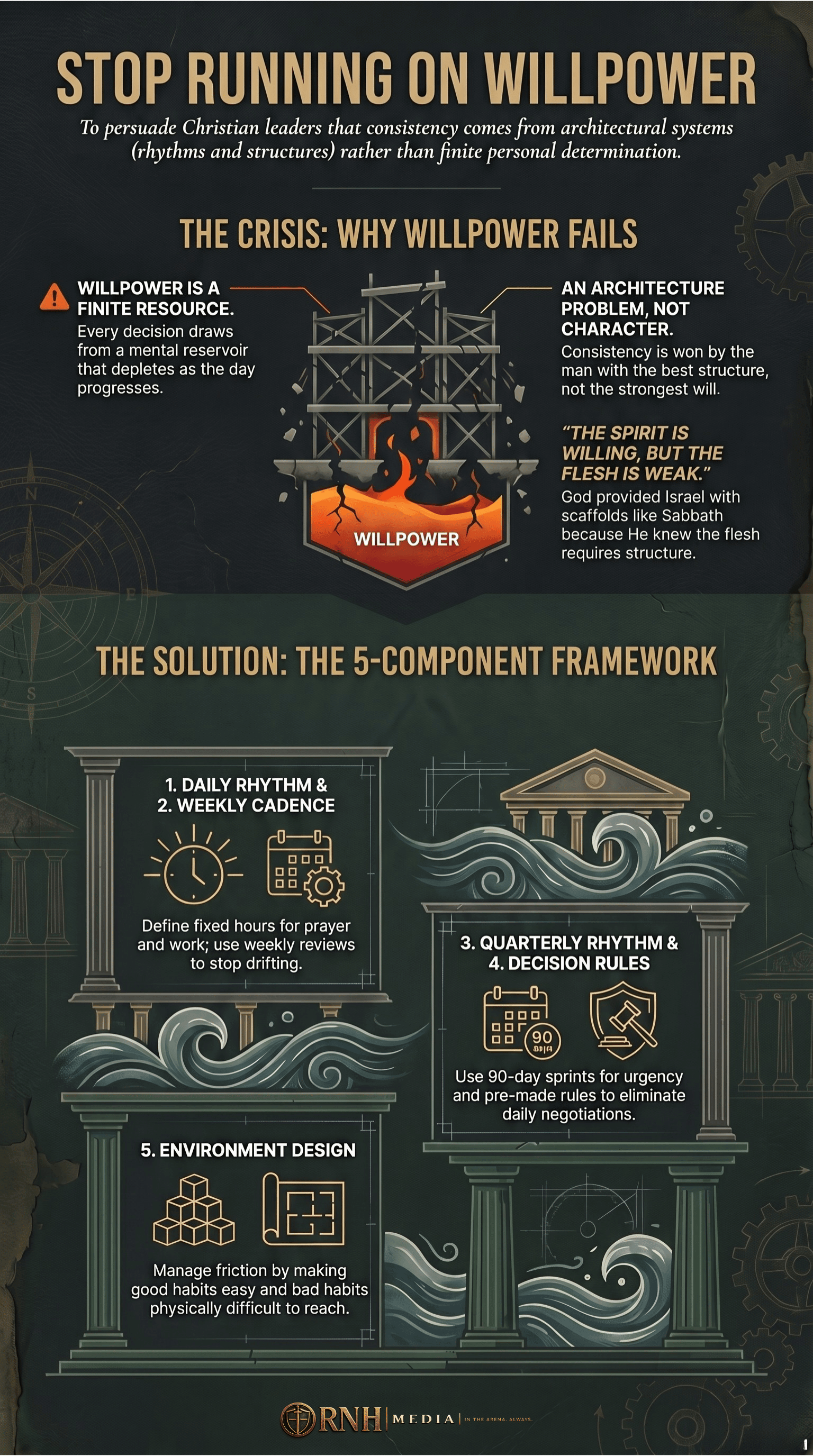
- Daily Rhythm
- Weekly Cadence
- Quarterly Rhythm
- Decision Rules
- Environment Design
Component 1: Daily Rhythm
The daily rhythm is the structure of your day: when you wake, when you pray, when you eat, when you do deep work, when you stop.
This sounds elementary. It is. Almost no leader actually has one. They have a calendar of meetings and a vague intention to handle everything else, which is why nothing else gets handled.
A real daily rhythm is written down. It survives travel. It accounts for the real shape of your life. If you are on dialysis three days a week, those days have a different rhythm than the others, and your system accounts for that rather than pretending it does not exist. A system that ignores your actual life is not a system. It is a wish.
A starter rhythm: wake at a fixed hour, ten minutes of Scripture before the phone, one hour of deep work before email, three meals at predictable times, a hard stop when family begins, devices out of the bedroom, and a defined sleep hour. That structure alone, held for ninety days, will compound in ways that feel miraculous by the end.
Component 2: Weekly Cadence
The weekly cadence is the shape of your week. Which days are for output? Which is for review. Which is for the Sabbath. Which days carry deep work requiring sustained focus, and which carry the shallow work requiring availability?
Most leaders run an undifferentiated week in which every day bleeds into the next. That is why they feel scattered. Their week has no shape, so they have no shape inside it.
A working cadence might look like: Monday for planning and alignment, Tuesday and Thursday for heavy output, Wednesday for creative deep work, Friday for review and admin, Saturday for family and rest, Sunday for worship and Sabbath. The shape is the point.
The engine of this component is the weekly review. Thirty minutes, same time, every single week: calendar review, project review, soul check. Skip it for a month, and you will drift. Run it consistently,y and you will feel, for the first time, like you are actually driving your life rather than being driven by it.
Component 3: Quarterly Rhythm
The annual goal is almost always dead by April. The problem is not your ambition. The problem is the time horizon.
Brian Moran and Michael Lennington's The 12 Week Year offers the cleanest fix. Treat every twelve weeks as a full year. Set 90-day objectives. Define the weekly tactics that move them forward. Track them weekly. Reset deliberately at the end of each cycle.
Twelve weeks is long enough to do serious work. It is short enough to maintain urgency. Your goals stay sharp throughout the cycle rather than fading into the background noise.
If you do not have a quarterly rhythm, your year is a slow drift toward resolutions you forgot in March. If you do, your year is four focused sprints with intentional rest built between them.
Component 4: Decision Rules
Decision rules are pre-made commitments that prevent you from re-litigating decisions you have already made in moments of Clarity.
Examples: I do not check email before 9 a.m. I do not take calls during family dinner. I do not take new clients during my busy season. I do not commit to anything with five-figure impact without a night to sleep on it. I do not say yes to travel commitments without first having a conversation with my partner. I do not respond to high-emotion requests within two hours of receiving them.
These rules look rigid. They are. That is the point.
Without them, every situation becomes a fresh negotiation, and every fresh negotiation is another opportunity for fatigue, fear, or flattery to push you somewhere you will regret. Most leaders have values as private aspirations. Decision rules are values made operational.
Your values are what you say you believe. Your decision rules are what you actually live by,.
Component 5: Environment Design
The environment is the most underrated component of a personal OS and the one that requires the least willpower to implement.
You will not consistently do hard things in an environment designed for easy things. If your phone is on your nightstand, you will scroll before you pray. If your office runs on notifications, you will not produce deep work. If your kitchen is stocked with junk, you will eat junk.
Designing your environment is not asceticism. It is friction management. Put friction in front of the things you do not want to do. Remove friction from the things you do.
A well-designed environment looks like: a phone that is harder to reach than your Bible, a workspace that is quiet by default, a pantry that is hostile to your worst patterns, a friendship circle that holds you to your best ones, a bedroom that is dark and cold, a car that is loaded with Scripture, or a teacher you respect rather than the news.
These are small changes. They compound in ways that feel disproportionate to the effort required.
There Is Still a Place for Willpower
Willpower is not worthless. Its role is just narrow.
You need willpower to install a new system before the system runs itself. The first thirty days of any new rhythm require activation energy, because the habit has not formed yet. After thirty days, the rhythm begins to carry itself, if willpower can stand down.
You also need willpower in a genuine crisis: a health emergency, a betrayal, a financial collapse, a death. The system pauses. Willpower carries you for es the next two weeks until you can rebuild.
Outside of those two windows, if you are constantly running on willpower, your system is broken. The solution is not more effort. It is a better architecture.
Three Ways Leaders Break Their Own Systems
Over-engineering. They design a perfect system on day one: forty habits, twelve rhythms, seven decision rules, a six-page weekly review. They run it for nine days, miss a session, declare it broken, and quit. A real system is built in stages. Start with two components. Run them for sixty days. Add one. Repeat.
Performance. They build the system to look disciplined to others, then quietly run a different life behind the scenes. There is no audience worth that. Build a system you would build if no one were watching, because the only person it needs to serve is you.
Rigidity. The system is a tool. It serves the man. The man does not serve the system. When a season changes, whether a new baby, a medical diagnosis, a business pivot, or a loss, the system has to adapt. A system that cannot bend with reality is not a system. It is a cage.
What a Working System Actually Looks Like
The leaders worth emulating do not look extraordinary on any given day. They look ordinary, consistently.
They show up. They produce. They are present with their families. They have time to read, pray, and think. They are not impressed with their own discipline because it does not feel like discipline. It feels like a life.
That is what a working personal OS produces. Not a hyper-optimized productivity warrior. A man who is unhurried and competent, faithful in small things, present where it counts, and predictable in the right ways, the ways that matter most to the people depending on him.
You will not get there by trying harder. Trying harder is the problem.
You will get there by building the system, trusting it, and letting it carry you for years.
Where to Start
Pick one component. Start there.
If your daily rhythm is broken, fix that first. Nothing else compounds without it.
If your day is solid but your week is chaotic, add the weekly cadence and review.
If your week is solid but you keep agreeing to things you regret, write the decision rules.
If your decision rules are clear but your environment keeps pulling you backward, redesign the environment.
If everything is clean except your quarterly rhythm is vague, install the 12 Week Year structure.
You do not need to build it all at once. You need to build the next thing well until it is automatic. Then build the next.
That is how a personal operating system gets built: slowly, in layers, by a man who has finally decided that willpower was never going to be the answer.
Take the Next Step
Take the Drift Diagnostic to identify which domain of your life is leaking the most under your current system. Takes less than five minutes.
Sign Up For The Foundry to do this work in a community of men building the same thing. This is where the system gets installed, tested, and held accountable. Applications open at the next intake.
Subscribe to The Arena Letter for weekly field notes on leading by rhythm, not reaction.
In The Arena. Always.
Take this with you. The full audio deep-dive on this framework is below. Share it with a leader in your circle who needs to hear it.