


You did not wake up one day and decide to drift. Nobody does. That is what makes it so dangerous.
In this episode, I break down the five domains where high-impact men lose their way, why leadership success actually accelerates drift, and the Anti-Drift Protocol I use every single week to stay on course.
This one is for the man who is doing all the right things on the outside but quietly feels the distance growing on the inside.
Listen now. Take notes. Then choose one correction before the week ends.

Nobody wakes up one morning and decides to fail.
Nobody sits down at their desk and thinks, “Today I will begin abandoning everything I said mattered to me.”
Failure for leaders is rarely a single catastrophic event. It is a series of small concessions, invisible compromises, and gradual departures from the convictions that once defined you.
That is drift.
Drift is the slow, imperceptible erosion of your standards, disciplines, and convictions. You do not feel it happening. You wake up one day and realize you are miles from the man you intended to become.
This guide exists to help you see drift before it destroys what matters most. You will learn what drift actually is, why leaders are uniquely vulnerable, how to diagnose drift across five key domains, and a simple weekly structure that keeps you on course as a faith-driven leader.
Quick start for this week
If you read nothing else, do this:
- Block fifteen minutes on your calendar before Sunday night
- Score yourself from 1 to 5 in the five domains of drift: spiritual, relational, physical, vocational, and intellectual
- Choose one concrete correction and put it on your calendar for this week
You can come back and build deeper structures later. The first win is awareness, followed by one act of obedience.
What drift actually is
Drift is not rebellion. Rebellion is obvious. Drift is subtle.
Rebellion announces itself. Drift whispers.
Drift looks like skipping your morning Bible reading because the day started early, and then skipping it again because yesterday felt fine without it, and then realizing three months later that you cannot remember the last time you opened Scripture outside of Sunday.
Drift looks like saying yes to one more commitment because it seems important, then another, until you are so overextended that you have no margin for the people you say matter most.
Drift looks like lowering your hiring standards because you need someone now. Or accepting mediocre work from your team because the hard conversation feels exhausting. Or letting your health slide because the business always seems to need you more than the gym does.
Each choice seems small and reasonable. Drift operates on compound interest. Small departures, compounded daily, create massive distance over time.
“Therefore, we must pay much closer attention to what we have heard, lest we drift away from it.” Hebrews 2:1.
Why leaders are uniquely vulnerable
Leaders drift because leadership creates the perfect environment for drift to thrive.
First, leaders are busy. Busyness creates the illusion of progress. If you are working fourteen hours a day, it feels like you must be moving forward. Activity is not direction. You can be busy and drifting at the same time. In many cases, busyness is the camouflage of drift. It keeps you too occupied to notice erosion.
Second, leaders are isolated. The higher you climb, the fewer people are willing to tell you the truth. Your team expects you to be strong. Your family hopes you will be present. Very few people want to be the one who says, “I think you are losing your way.” Silence keeps you comfortable and drifting.
Third, leaders are competent. Competence is the enemy of dependence. When you are gifted, it becomes easy to operate from talent rather than conviction. You can lead effectively for years on pure skill while your spiritual foundation quietly erodes. Results keep coming. The fruit looks good. The root system is dying.
If you do not intentionally fight drift, leadership success will eventually make you vulnerable to it.
The five domains of drift
Drift does not attack one area of your life. It works like a slow leak in every compartment.
You can use these five domains as your weekly dashboard.
1. Spiritual drift
Spiritual drift is the departure from practiced dependence on God. Your prayer life becomes performative or shallow. Your time in Scripture becomes irregular or purely academic. Decision-making shifts from “Lord, what do you want??” to “What does the market say, and what does my gut say?”
Warning sign: You cannot name a specific moment in the last seven days when you heard from God in prayer or in His Word.
Simple correction this week: Pick a single passage, such as Proverbs 3 or James 1, and meet God over it at a specific time tomorrow before you open email.
2. Relational drift
Relational drift turns covenant relationships into transactions. Your marriage runs on logistics and calendar invites. Friendships become networking. You accumulate contacts and lose brothers.
Warning sign: The people closest to you would describe you as “busy” before they would describe you as “present.”
Simple correction this week: Schedule one distraction-free hour with your wife, your kids, or a brother. No agenda. No phone. Ask the questions you have been avoiding.
3. Physical drift
Physical drift is poor stewardship of your body. Sleep becomes a luxury you keep postponing. Exercise gets bumped to “next week.” Nutrition becomes whatever is fastest and closest to the drive-through.
Warning sign: Your energy is consistently low, and you prop yourself up with caffeine and adrenaline.
Simple correction this week: Choose one small lever, such as going to bed thirty minutes earlier twice, taking a fifteen-minute walk each day, or replacing one processed meal with something simple and whole.
4. Vocational drift
Vocational drift is when your work loses its connection to calling. You are no longer building something that matters. You are maintaining something that pays. The vision that once energized you has faded under the weight of operations and obligations.
Warning sign: When someone asks why you do what you do, you cannot answer without talking about money or metrics.
Simple correction this week: Write a one-paragraph statement of calling. Why does your work matter to God, to the people you serve, and to the men you lead?
5. Intellectual drift
Intellectual drift is the quiet decision to stop learning. You stop reading. You stop engaging with ideas that challenge your assumptions. You recycle the same strategies that worked five years ago and call it leadership.
Warning sign: You cannot remember the last book, sermon, or conversation that genuinely changed your thinking.
Simple correction this week: Pick one high-quality book, message, or article and engage with it deeply for thirty minutes. Take notes. Ask what must change as a result.
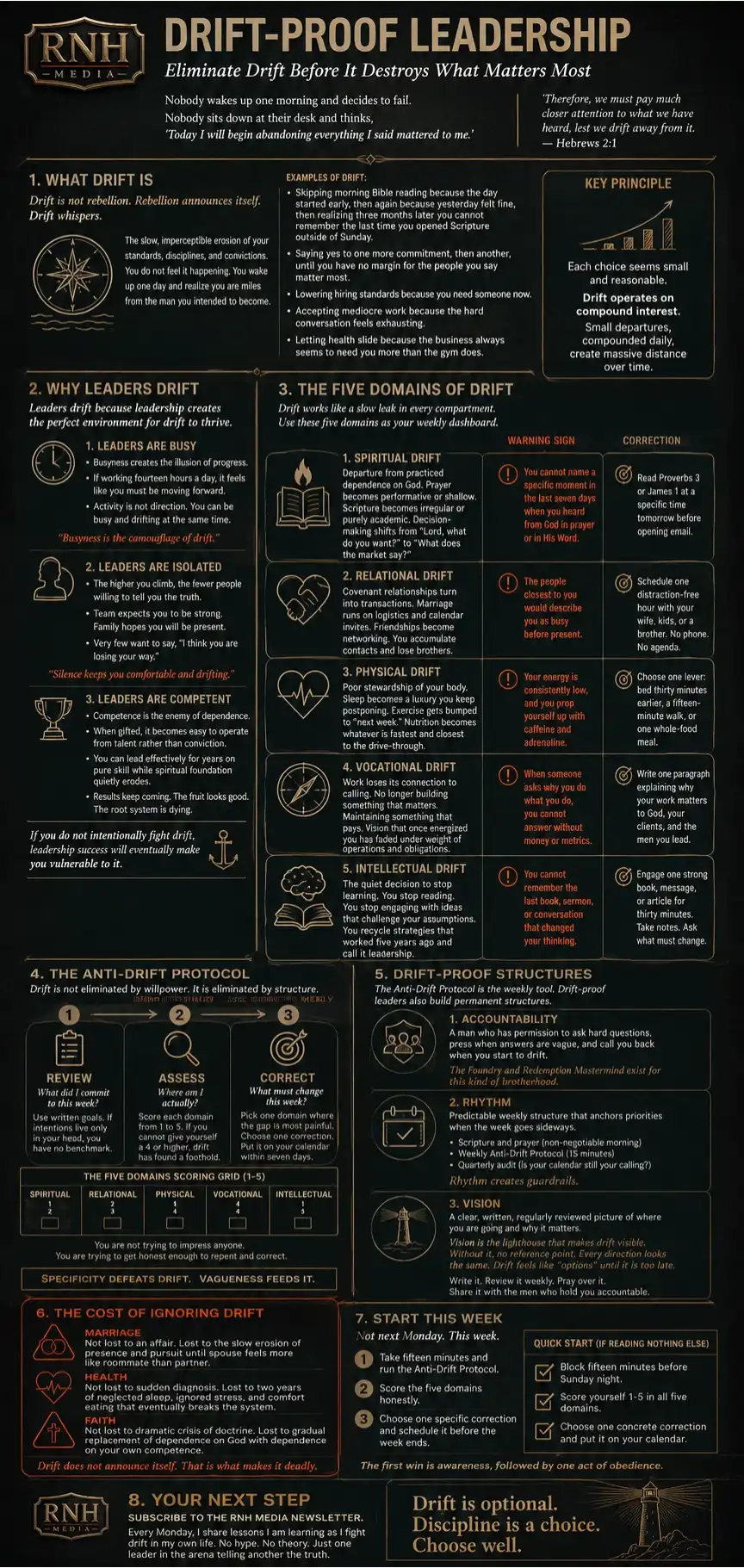

The Anti-Drift Protocol
Drift is not eliminated by willpower. It is eliminated by structure.
The Anti-Drift Protocol is a weekly practice that takes fifteen minutes and prevents the slow erosion that destroys leaders.
Step 1. Review
Ask: What did I commit to this week? Not what happened to me. What did I intend to do?
You need written goals. If your intentions live only in your head, you have no benchmark against which to measure drift. Capture your commitments for the week in a notebook or digital system. Then, at the end of the week, review them with brutal honesty.
Step 2. Assess
Ask: Where am I actually? Not where do I want to be. Not where do I tell others I am. Where am I in reality?
Score each of the five domains from 1 to 5. If you cannot give yourself a 4 or higher, drift has found a foothold.
You might use a simple grid like this:
- Spiritual: 1 to 5
- Relational: 1 to 5
- Physical: 1 to 5
- Vocational: 1 to 5
- Intellectual: 1 to 5
You are not trying to impress anyone. You are trying to get honest enough to repent and correct.
Step 3. Correct
Ask: What must change this week? Not this month. Not this quarter. This week.
Drift is reversed by immediate, specific action. “Read the Bible more” is not a correction. “Read Proverbs 3 at 6:00 am tomorrow before I open email” is a correction.
Specificity defeats drift. Vagueness feeds it.
Pick one domain where the gap between where you are and where you want to be is most painful. Then choose one correction and put it on your calendar within the next seven days.
Building drift-proof structures
The Anti-Drift Protocol is the weekly tool. Drift-proof leaders also build permanent structures around their lives.
Structure 1. Accountability
You need structured accountability, not the casual kind where someone asks, “How are you?” and you say, “Fine.” You need a man who has permission to ask hard questions, press when your answers are vague, and call you back when you start to drift.
That is what the Redemption Mastermind and The Foundry exist for. They are cohorts of men who refuse to let you drift unnoticed and who hold their own feet to the same fire.
Structure 2. Rhythm
You need rhythm. A predictable weekly structure that anchors your priorities even when the week goes sideways.
This might include:
- A non-negotiable morning practice in Scripture and prayer
- A weekly review using the Anti-Drift Protocol
- A quarterly audit where you step back and ask whether your calendar still reflects your calling
Rhythm creates guardrails. It keeps you from living at the mercy of urgent requests and emotional swings.
Structure 3. Vision
You need vision—a clear, written, regularly reviewed picture of where you are going and why it matters.
Vision is the lighthouse that makes the rift visible. Without it, you have no reference point. Every direction looks the same. Drift feels like “options” until it is too late.
Write your vision. Review it weekly. Pray over it. Share it with the men who hold you accountable.
The cost of ignoring drift
I have seen leaders lose their marriages due to drift. Not to an affair. To the slow erosion of presence and pursuit until one day their spouse feels more like a roommate than a partner.
I have seen leaders lose their health to drift. Not to a sudden diagnosis. Two years of neglected sleep, ignored stress, and comfort eating that eventually breaks the system.
I have seen leaders lose their faith and drift. Not to a dramatic crisis of doctrine. To the gradual replacement of dependence on God with dependence on their own competence.
Drift does not announce itself. That is what makes it deadly.
You cannot afford to ignore it.
Your next step
Start this week. Not next Monday. This week.
- Take fifteen minutes and run the Anti-Drift Protocol
- Score the five domains honestly
- Choose one specific correction and schedule it before the week ends
If you want weekly content designed to keep you sharp, accountable, and drift-proof, subscribe to the RNH Media newsletter. Every Monday, I share the lessons I am learning as I fight drift in my own life. No hype. No theory. Just one leader in the arena telling another the truth.
Drift is optional. Discipline is a choice. Choose well.
In the arena. Always.
If you tell me your primary traffic source for this article right now (search, newsletter, social, or referrals), I can tailor the meta title, description, and first two paragraphs even more precisely to that channel.
Ryan Nelson Holt | Founder, RNH Media
Leading, Building, and Fighting the Good Fight
You did not wake up one day and decide to drift. Nobody does. That is what makes it so dangerous.
In this episode, I break down the five domains where high-impact men lose their way, why leadership success actually accelerates drift, and the Anti-Drift Protocol I use every single week to stay on course.
This one is for the man who is doing all the right things on the outside but quietly feels the distance growing on the inside.